
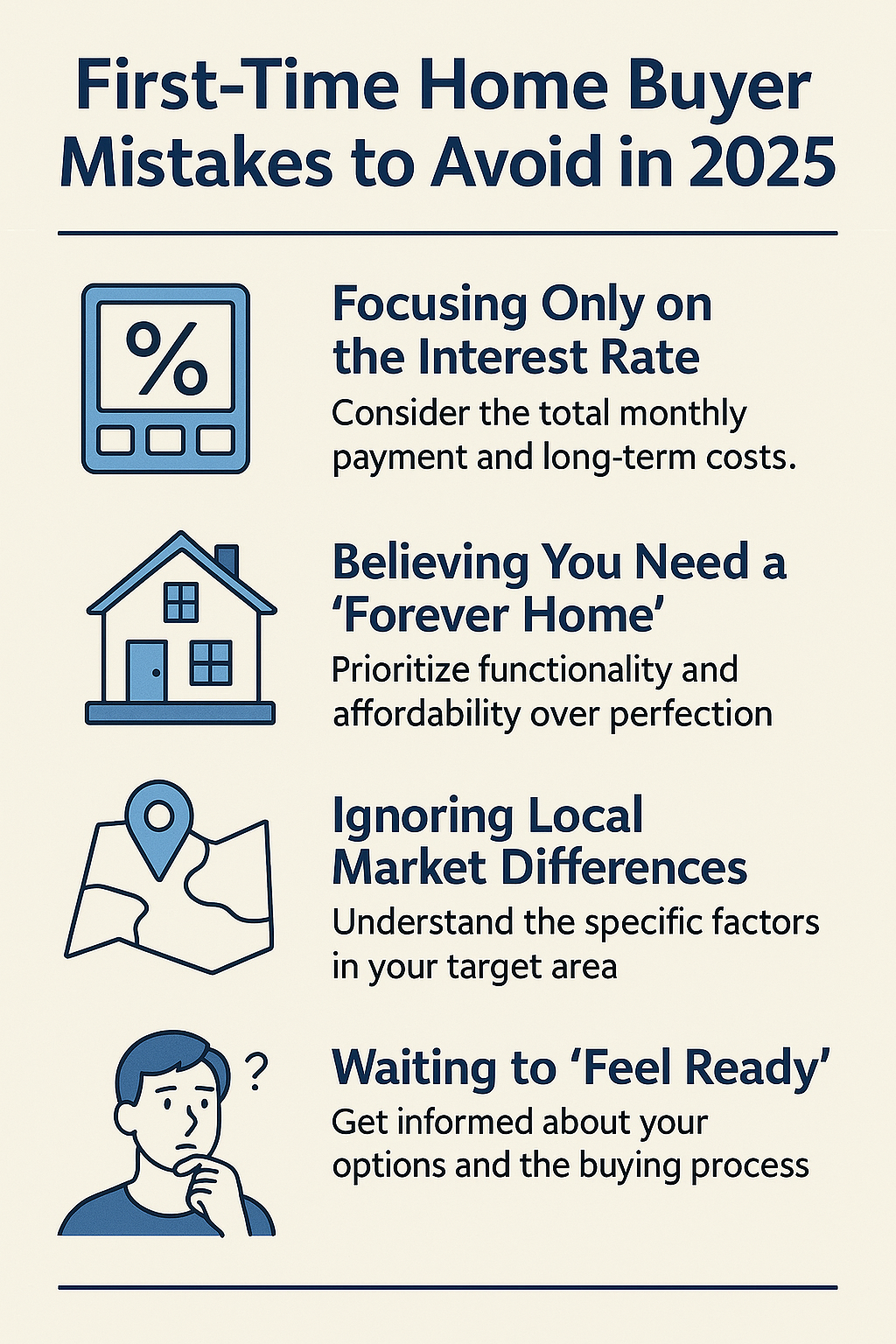
What First-Time Home Buyers Get Wrong in 2025, and How to Avoid Costly Mistakes
Buying your first home in 2025 can feel overwhelming, not because people lack information, but because there is too much of it. Advice comes from social media clips, headlines, family members, and online calculators that rarely explain the full context.
Many first-time buyers believe they are doing something wrong when the process feels confusing. In reality, most buyers struggle because they are taught the wrong priorities.
This article breaks down the most common mistakes first-time buyers make in 2025, why those mistakes happen, and how to approach the process with clarity instead of pressure. The goal is not to push buying at any cost. The goal is to help buyers make decisions that actually fit their lives.
Mistake #1: Focusing Only on the Interest Rate
Interest rates dominate headlines, and understandably so. A difference of one percentage point can change a monthly payment noticeably. But many first-time buyers treat interest rates as the single deciding factor, and that narrow focus can lead to missed opportunities.
Rates matter, but they are only one piece of the affordability equation.
According to Freddie Mac’s Primary Mortgage Market Survey, rates fluctuate over time, often in response to broader economic conditions. Buyers who wait indefinitely for a “perfect” rate may find that home prices or rents continue rising during that waiting period.
The more important question is not “Are rates low?” but “Is the total monthly payment comfortable and sustainable?”
That total includes:
- Mortgage principal and interest
- Property taxes
- Homeowners insurance
- HOA dues, if applicable
- Maintenance and utilities
When buyers focus only on rates, they often underestimate the role of price, taxes, and long-term rent inflation.
Mistake #2: Underestimating How Much Rent Increases Matter
Many first-time buyers delay purchasing because renting feels cheaper or safer. What often gets overlooked is how quickly rent increases compound.
According to national rent data published by Apartment List, rents remain significantly higher than pre-2020 levels, even in markets where growth has slowed.
A renter paying $1,800 today may face $2,100 or more within a few lease cycles. Unlike a mortgage payment, rent increases provide no long-term benefit to the renter.
This does not mean renting is always a bad choice. It means renters should understand the long-term tradeoff.
Mistake #3: Believing You Need a “Forever Home” as a First-Time Buyer
One of the most damaging myths in real estate is the idea that your first home must be your forever home.
For most buyers, the first home is a stepping stone. It is a place to build equity, stabilize housing costs, and gain experience as a homeowner.
When buyers insist on finding a home that checks every possible future box, they often delay purchasing indefinitely. This can result in higher prices, higher rents, and missed equity growth.
A more realistic approach is to ask:
- Does this home fit my life for the next three to five years?
- Is the payment comfortable?
- Is the location practical for work and daily life?
Buying a first home is not about perfection. It is about functionality.
Mistake #4: Ignoring Local Market Differences
National housing headlines rarely reflect what is happening in specific regions. This is where first-time buyers get tripped up.
Affordability, taxes, insurance costs, and inventory vary dramatically by state and even by county. A strategy that makes sense in one market may be ineffective in another.
That is why buyers benefit from localized education. For example, buyers researching Midwest affordability often compare Illinois with neighboring states. In regions like Northwest Indiana, housing costs, property taxes, and space often look very different.
Local market guides published by brokerages that focus on education, such as those found at Realest.com, help buyers understand how national trends play out locally.
Mistake #5: Waiting to “Feel Ready” Instead of Getting Informed
Many first-time buyers delay action because they do not feel ready. In most cases, the problem is not readiness, but lack of clear information.
Readiness comes from understanding:
- Your budget range
- Your monthly comfort zone
- Your timeline
- Your local market options
Getting informed does not require committing to buy. It requires education.
Neutral resources like the Consumer Financial Protection Bureau home buying guides exist to help buyers understand the process without pressure.
The biggest cost of waiting is often uncertainty itself.
Mistake #6: Treating Buying as a Financial Trick Instead of a Lifestyle Decision
Buying a home is a financial decision, but it is also a lifestyle decision. First-time buyers who focus only on spreadsheets often overlook daily quality-of-life factors.
Consider:
- Commute time
- Access to amenities
- Community fit
- Space needs
- Future flexibility
A home that looks perfect on paper can feel wrong in practice.
Mistake #7: Assuming You Need to Time the Market Perfectly
Market timing is one of the most misunderstood ideas in real estate. First-time buyers often believe they need to buy at the absolute bottom.
In reality, most long-term homeowners succeed by buying when the payment fits their life and staying long enough to benefit from stability and equity.
According to long-term data from the Federal Housing Finance Agency, housing values tend to rise over extended periods despite short-term fluctuations.
The more important factor is time in the home, not timing the market.
Part 1 conclusion: Most first-time buyer mistakes in 2025 come down to misaligned priorities, not lack of effort. Buyers who focus on clarity, local context, and long-term comfort make better decisions than those chasing perfect conditions.
How First-Time Buyers Should Actually Evaluate Affordability in 2025
Affordability is not a number pulled from a calculator. It is a lived experience. First-time buyers who succeed in 2025 evaluate affordability through comfort, flexibility, and resilience rather than pushing to the maximum they are technically approved for.
Mortgage pre-approvals often show the highest possible loan amount, not the healthiest one. Buyers who focus only on approval limits often feel house-poor quickly.
A healthier approach is to define a monthly housing range that allows:
- Room for savings
- Room for lifestyle expenses
- Room for unexpected costs
- Room for future changes
This mindset reduces stress and increases long-term satisfaction with the purchase.
The First-Time Buyer Self-Test for 2025
If you are unsure whether buying makes sense right now, this short self-test helps frame the decision without pressure.
Time Horizon
- Planning to stay less than 2 years, renting may still be appropriate.
- Planning to stay 3 years or more, buying becomes more competitive.
Monthly Comfort
- Would a stable payment feel better than unpredictable rent increases?
- Can you comfortably handle housing costs without cutting essentials?
Stability
- Is your income reasonably predictable?
- Do you have emergency savings separate from your down payment?
Control vs Flexibility
- If flexibility matters most, renting may still fit.
- If control and long-term planning matter more, ownership may fit better.
If most answers lean toward stability and predictability, buying deserves serious consideration. If flexibility and uncertainty dominate, renting may still serve your current stage.
Why Local Knowledge Matters More Than Ever
National advice is useful, but housing decisions are ultimately local. Taxes, insurance, commute patterns, and inventory vary dramatically by region.
This is why buyers increasingly rely on local educational resources, not just national averages. Understanding how a national trend shows up in a specific community helps buyers avoid surprises.
For buyers researching Midwest affordability, particularly in Northwest Indiana, local guides and market explanations published by brokerages like Realest help translate national data into real expectations. These resources are available at https://www.realest.com/blog.
Common Emotional Traps First-Time Buyers Fall Into
Buying a first home is emotional. That does not make buyers irrational, but it does make certain traps more likely.
- Fear of missing out, rushing decisions
- Fear of overpaying, delaying indefinitely
- Comparison paralysis, analyzing too many options
- Perfectionism, waiting for a home that does not exist
The most successful buyers acknowledge these emotions without letting them drive the decision.
What Successful First-Time Buyers Do Differently
Buyers who feel good about their decision years later tend to share common habits:
- They focus on monthly comfort, not maximum approval
- They understand their local market
- They accept tradeoffs consciously
- They plan for 3 to 5 years, not forever
- They view buying as stability, not speculation
This mindset creates confidence, even in uncertain markets.
Frequently Asked Questions
Is 2025 a bad year to buy a first home?
No year is universally good or bad. The right time depends on affordability, stability, and local market conditions.
Should first-time buyers wait for rates to drop?
Waiting may help, but rising rents and prices often offset rate changes. Payment comfort matters more than timing.
How much should first-time buyers put down?
Down payment requirements vary by loan type. Many buyers qualify with less than twenty percent, depending on program eligibility.
Is buying risky for first-time buyers?
Buying involves responsibility, but long-term risk is often lower than renting due to equity growth and payment stability.
Where can I learn without sales pressure?
The Consumer Financial Protection Bureau offers neutral guidance at consumerfinance.gov. Local market education can be found at realest.com/blog.
If you want to explore real housing options and price ranges in your area, you can browse available listings using the search tool below. Browsing is free and does not require commitment.
Image Metadata (Copy Into CMS)
Image Alt Text: First-time home buyer guide in 2025 explaining common mistakes and how to avoid them
Image Title: First-Time Home Buyer Mistakes to Avoid in 2025
Image Description: Educational graphic used in a RealEstateUSA.com guide explaining first-time home buyer mistakes, affordability considerations, and decision-making tips for 2025.