
If you buy a home in Indiana with a mortgage, your lender will want proof of homeowners insurance before you sign for the loan. Insure the house for what it costs to rebuild, not the sale price, and check two gaps a standard policy leaves open in Northwest Indiana: flooding and sewer or drain backup.
Buying soon? Call Realest at (219) 808-1520.
It’s noon on a gray Wednesday in Hammond. A buyer sits in her car across from a brick two-story on a quiet corner, the inspection report on the passenger seat.
The offer went through on Monday. The lender emailed this morning asking who her insurance company is.
She has her phone on speaker with an agent. He asks what year the house was built, whether it’s brick or frame, and how far it is to the fire station.
Then he asks if the basement has a sump pump. She flips to page nine of the report. It does.
Why the lender asks for insurance
The Consumer Financial Protection Bureau (CFPB) says homeowners insurance pays for losses and damage to your property if something unexpected happens, like a fire or a burglary. When you have a mortgage, the lender wants the house protected, so it asks for proof of coverage.
The CFPB’s closing guide says your lender will likely require you to arrange homeowners insurance before you can sign for the loan. Once you have quotes, share them with your loan officer so they can check the policy meets the lender’s rules.
Homeowners insurance isn’t mortgage insurance. Mortgage insurance protects the lender if you stop paying, and our private mortgage insurance guide covers that one.
Shop it like you shopped the loan
The CFPB says the estimated insurance cost is listed on page one of your Loan Estimate, under Projected Payments. It also says you can shop for homeowners insurance on your own and pick the company and plan.
Start right after your offer is accepted. That leaves time to compare two or three quotes, ask questions, and get proof to the lender without a scramble the week of closing.
The National Association of Insurance Commissioners (NAIC) lists what moves the price. A house that’s mostly brick or masonry costs less to insure than a wood frame house. The distance from the house to a fire department or a water source counts too. Your deductible, your claims history, and the coverage you pick matter too.
What a homeowners policy covers
| Coverage | What it pays for |
|---|---|
| Dwelling | The house itself, up to the dwelling limit you pick |
| Other structures | A detached garage, a shed, or a fence |
| Personal property | Furniture, clothes, and appliances you own |
| Loss of use | Extra living costs if a covered loss forces you out for a while |
| Personal liability | Claims if someone is hurt on your property and sues |
| Medical payments | Small medical bills for a guest hurt at your home |
| Not in a standard policy | Flood and earthquake, and limited or no sewer backup coverage |
Based on the NAIC Consumer’s Guide to Home Insurance and the CFPB. Your own policy language controls. Checked October 28, 2026.
Insure the rebuild, not the price
The NAIC says your dwelling coverage should equal the full replacement cost of the home. Replacement cost and market value aren’t the same. The price you paid includes the land, and you don’t need to rebuild the land after a fire.
The Indiana Department of Insurance says to insure your home for at least 80% of its replacement value. With that, the company pays covered losses in full, minus the deductible, up to the policy limit. Below 80%, a claim is settled on actual cash value, which takes depreciation out.
Ask each agent whether the quote is replacement cost or actual cash value, for the house and for your belongings. The NAIC says you can pick either, and the difference shows up when you file a claim.
The two gaps to ask about
Back in the car, the sump pump question makes sense.
The NAIC says homeowners policies offer limited or no coverage for sewer or drain backups and sump pump overflow. You can buy an endorsement that adds it. In a part of the state full of basements, ask about this one on every quote.
Flood is the other gap. The CFPB says standard homeowners insurance doesn’t cover flood damage. Flood policies come through the National Flood Insurance Program or a private insurer, and our flood insurance guide explains the maps, the zones, and the waiting period.
Homeowners insurance timeline for buyers
| When | What to do | Source |
|---|---|---|
| After your offer is accepted | Ask two or three agents for quotes on the house | CFPB |
| When the Loan Estimate arrives | Compare your quotes to the insurance estimate on page one | CFPB |
| Before you sign for the loan | Send the lender proof of coverage that meets its rules | CFPB |
| At closing | The policy starts, and escrow can collect the insurance share each month | CFPB |
| If coverage lapses later | The servicer sends a notice 45 days before charging, then a reminder | Federal rule, 12 CFR 1024.37 |
| Every year | Review the dwelling limit against what it costs to rebuild | Indiana Department of Insurance |
Paying through escrow
The CFPB says many homeowners pay insurance through an escrow account. You pay the insurance share with your monthly mortgage payment, the lender holds it, and the lender pays the bill when it’s due. Our escrow account guide walks through how the account works with property taxes too.
If coverage lapses later
Under federal rule 12 CFR 1024.37, a servicer that buys force-placed insurance has to mail you a written notice at least 45 days before charging you, then a reminder. If you show proof of continuous coverage within 15 days of the reminder, it can’t charge you.
The CFPB warns that coverage the lender buys may protect only the lender, not you, and may cost more than a policy you buy yourself. If you have an escrow account and you’re not more than 30 days behind, the federal bank regulator’s help site says your bank must advance the premium to keep your own policy going, with some exceptions.
After you move in
The Indiana Department of Insurance says to make an inventory of your belongings, keep a copy away from the house, and review your coverage at least once a year as building costs change.
Its claim tips page adds a warning. Indiana law limits why a company can cancel a homeowners policy, but nothing makes a company renew it, and insurers can look at your claims when deciding. The NAIC says if a repair costs little more than your deductible, you might pay it yourself instead of filing.
The same page says to take photos before temporary repairs and not to make permanent repairs before the company inspects. Our winterizing guide covers the pipes and the furnace, so you file fewer claims in the first place.
Can’t find a company to write a policy? The Indiana Department of Insurance lists the Indiana FAIR Plan among its homeowners resources.
Back in Hammond
The buyer asks for a replacement cost quote with a sewer backup endorsement and a $1,000 deductible. She asks a second agent for the same thing that afternoon.
By Friday she sends the lender the declarations page. Closing is three weeks out, and that box is checked.
Looking at homes nearby? See the Hammond, Highland, and Munster pages on Realest. Before you insure the house, our inspection contingency guide and title commitment guide cover the other papers on your list.
Work with Realest
Browse homes for sale with Realest or send us a note.
Own a home already? Ask for your home value and we’ll pull the recent sales near you.
Call the shop at (219) 808-1520.
Pamela “Pam” Joveski is the founding owner of Realest. Realest Realty is at 112 S. Main St., Suite B, Crown Point, and we are licensed in Indiana and Illinois.
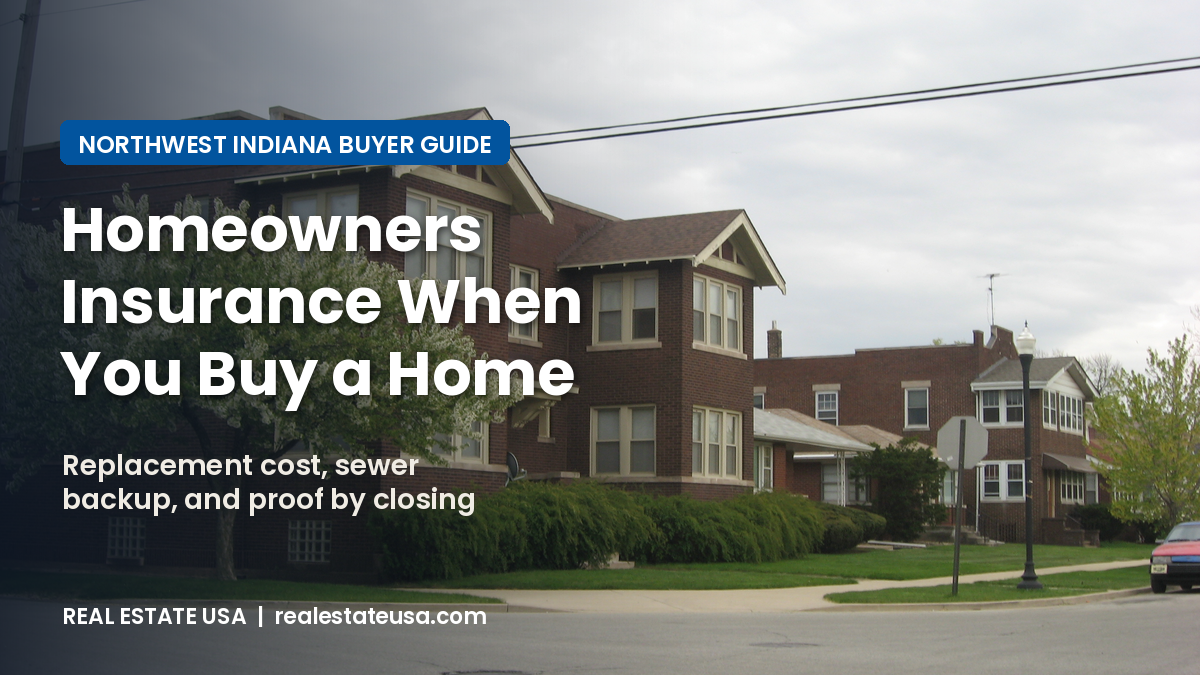
Photo by Nyttend of the 1600 block of Davis Avenue in the Robertsdale neighborhood of Hammond, Indiana, April 2012, public domain, via Wikimedia Commons. Cropped, text added. Shown for illustration only. It is not a Realest listing.

Insurance rules and policies change. This is general information, not insurance or legal advice. Talk with a licensed insurance agent about your home. The Hammond buyer is an example, not a real client.
Sources
- CFPB: What is homeowner’s insurance? Why is homeowner’s insurance required?
- CFPB: The essential steps to close on your home with confidence
- CFPB: 12 CFR 1024.37, Force-placed insurance
- HelpWithMyBank.gov: Can the bank make me buy more expensive insurance?
- NAIC: A Consumer’s Guide to Home Insurance
- Indiana Department of Insurance: Property Insurance
- Indiana Department of Insurance: Insurance Claim Tips
- Indiana Department of Insurance: Types of Insurance
- National Flood Insurance Program: FloodSmart
Ask Realest
Got a short question about insuring the house you’re buying?
Ask Realest answers short buyer and seller questions in plain English.
When you’re ready to talk it through, contact us, search homes for sale, or call (219) 808-1520.
FAQ
Do I need homeowners insurance to close on a house in Indiana?
If you’re getting a mortgage, yes in practice. The Consumer Financial Protection Bureau says your lender will likely require homeowners insurance before you sign for the loan. A cash buyer has no lender asking for it, but it’s still smart to line up a policy that starts on closing day. A licensed insurance agent can help you pick the coverage.
Does homeowners insurance cover flooding or a sewer backup?
Not in a standard policy. The CFPB says standard homeowners insurance doesn’t cover flood damage, and the National Association of Insurance Commissioners says policies offer limited or no coverage for sewer or drain backups and sump pump overflow. You can buy flood insurance separately and ask your agent about a sewer and drain backup endorsement.
How much dwelling coverage should I buy?
Enough to rebuild the house, not the purchase price. The NAIC says coverage should equal the full replacement cost, which leaves out the land. The Indiana Department of Insurance says to insure for at least 80% of replacement value, because below that a claim is settled on actual cash value, with depreciation taken out.
Can I pay homeowners insurance through my mortgage?
Yes, through an escrow account. The CFPB says you pay the insurance share with your monthly mortgage payment, the lender holds it, and the lender pays the bill when it comes due. The estimated cost shows on page one of your Loan Estimate.
What happens if my homeowners insurance lapses after closing?
Your loan servicer can buy coverage and charge you for it. Under federal rules, the servicer has to send a written notice at least 45 days before charging you, then a reminder, and give you 15 days after the reminder to show proof of coverage. That insurance may protect only the lender and cost more than your own policy.
How do I talk to Realest about buying a home in Northwest Indiana?
Call the shop at (219) 808-1520 or send us a note through our contact page. We can walk you through the steps from offer to keys, including when to get your insurance quotes.