
Renting vs Buying in 2025: The Real Cost Breakdown Most Buyers Never See
Let’s be honest, the rent versus buy conversation in 2025 can feel like a mental tug of war.
Renting feels “safer.” Buying feels “smarter.” Renting feels flexible. Buying feels permanent. Then you check your rent renewal, see another increase, and suddenly you are back on Google asking the same question everyone is asking right now.
Should I keep renting, or is it finally time to buy?
This guide is not here to guilt you into homeownership. It is here to give you clarity. We are going to compare renting versus buying the way a calm, practical person would. We will look at costs you can see, costs you cannot see, and the long-term math most people skip.
Why This Question Hits Harder in 2025
Housing costs have become the main character in household budgets. Not because people are dramatic, but because housing is usually the biggest monthly expense, and it has been rising fast in many places.
If you want the most neutral way to understand housing pressure, start with objective data. The U.S. Bureau of Labor Statistics CPI data tracks inflation categories, including shelter-related inflation. It is not a headline, it is a trend line.
On the buying side, mortgage rates are no longer “shock and awe” every week. They have become more predictable compared to recent years. If you want a straightforward benchmark, Freddie Mac’s Primary Mortgage Market Survey is widely referenced for weekly rate trends.
So the real story in 2025 is not just mortgage rates. It is the combination of:
- Rent growth that keeps pushing monthly budgets higher
- Higher borrowing costs that make payment math feel heavy
- Home prices that may grow slower, but still matter
- Household goals that are shifting toward stability and predictability
The True Cost of Renting in 2025
Renting looks simple. You pay monthly. The landlord handles repairs. You can move if life changes.
All of that is real. But renting has hidden costs that build quietly.
1) Rent is not fixed, and it rarely stays flat
Many renters do not realize how powerful small increases become over time. A modest annual rent increase becomes a bigger payment every year, and the renter does not build ownership along the way.
If you want a reputable snapshot of rent trends, Apartment List rent research provides national reporting and directional movement. For another large data set, the Zillow Research hub is a useful reference point.
2) Moving costs add up, even when you do not notice
Renting is often paired with moving more frequently. That flexibility is valuable, but it is not free. Consider the real costs that show up every time you move:
- Deposits and fees
- Truck, movers, supplies
- Time off work or schedule disruption
- Utility setup costs
- Replacing items that do not fit the new space
3) The opportunity cost, no equity
Renting can be the right choice for many people. But one unavoidable truth is that rent payments do not create equity. You are paying for the right to live there, which is not wrong, but it is not an asset-building strategy.
You are unsure about location, your income is unstable, you plan to move within two years, or you are rebuilding credit and cash reserves.
The Real Cost of Buying in 2025
Buying has more moving parts. That is why it scares people. But buying also gives you two things renting does not.
Predictability and ownership.
1) Ownership costs go beyond the mortgage payment
Buying is not just principal and interest. A realistic ownership budget includes:
- Mortgage principal and interest
- Property taxes
- Homeowners insurance
- HOA dues if applicable
- Maintenance, repairs, and replacements
If you want an excellent consumer-friendly explainer on mortgages and total loan costs, the Consumer Financial Protection Bureau (CFPB) homebuying resources are among the best neutral guides available.
2) Equity is the quiet advantage that changes your long-term math
When you buy, part of your monthly payment goes toward principal over time. That is equity. You are gradually converting monthly housing cost into ownership. You can also gain equity through value appreciation, which is never guaranteed in the short term, but historically has been meaningful over long periods.
If you want a reputable source for long-run home price tracking, FHFA (Federal Housing Finance Agency) publishes house price indexes and research.
3) Buying also gives you control
Control is not just emotional. It is practical. Homeowners can improve their home, stabilize their housing costs, and make decisions without needing permission. That control often becomes more valuable as families grow, careers stabilize, and routines become important.
The Comparison Most People Skip: Monthly Payment vs Total Cost Over Time
Most rent versus buy arguments stop at the monthly payment. That is incomplete.
The real comparison is:
- What does your monthly housing cost do over 3 to 5 years?
- Do you gain anything from that spending?
- Do you have flexibility if life changes?
Rent typically increases. Ownership often stabilizes. That does not automatically mean buying wins, but it changes the long-term story.
- If you plan to stay under 2 years, renting often makes more sense.
- If you plan to stay 3 to 5 years, buying becomes more competitive, especially if rent is rising.
- If your income is stable and you want payment predictability, ownership often becomes a lifestyle upgrade, not just a financial choice.
When Renting Makes Sense in 2025
Renting is not “throwing money away” in every scenario. That phrase is overused and not helpful. Renting can be smart when it protects your flexibility or reduces risk.
Renting often makes sense if:
- You are planning a job change or relocation soon
- You are paying off high-interest debt and building reserves
- You are repairing credit and need time
- You are unsure which neighborhood fits your lifestyle
- You want low responsibility while life is changing quickly
When Buying Makes Sense in 2025
Buying tends to make sense when your life is stable enough to benefit from ownership. This is less about “timing the market,” and more about timing your life.
Buying often makes sense if:
- You plan to stay in the area at least 3 to 5 years
- Your income is stable and your budget is realistic
- You want more control over your home and monthly housing cost
- You are ready to build long-term equity
- You want a home that fits your life stage, not your landlord’s policy
Why Local Market Examples Matter, Northwest Indiana as a Practical Case Study
National averages can be misleading because rent and home prices vary wildly by region. That is why local case studies matter. In many Midwest markets, monthly rent and monthly ownership can be surprisingly close, and sometimes ownership wins.
Northwest Indiana is a great example of how affordability can look different outside of major urban cores. It has also become a frequent landing zone for Chicago-area buyers who want more space and lower overall cost of living, while staying within reach of the city.
If you are researching how national trends show up locally, Realest publishes consumer-friendly guides and community content here: https://www.realest.com/blog.
If you are exploring home options and want to browse what is available without committing to anything, you can use the search tool at the end of this article. It is built to help you compare neighborhoods and price points quickly.
Frequently Asked Questions
Is renting cheaper than buying in 2025?
Sometimes, especially in the short term. Over longer periods, buying can be competitive or cheaper monthly depending on rent growth and local pricing. The time horizon is a major factor.
How long should I plan to stay for buying to make sense?
Many buyers use 3 to 5 years as a practical benchmark, but local conditions and your personal plans matter.
Do mortgage rates make buying a bad idea?
Not automatically. Rates matter, but base home prices, your down payment, and rent inflation often matter just as much. Many buyers also choose to refinance later if rates decline.
What is the biggest mistake people make when comparing rent to buy?
They compare rent to the mortgage payment only, instead of comparing rent to total ownership cost and long-term equity effects.
Where can I learn the homebuying process without sales pressure?
The CFPB has strong educational resources: https://www.consumerfinance.gov/owning-a-home/. For localized guides in Northwest Indiana, Realest maintains a consumer blog at https://www.realest.com/blog.
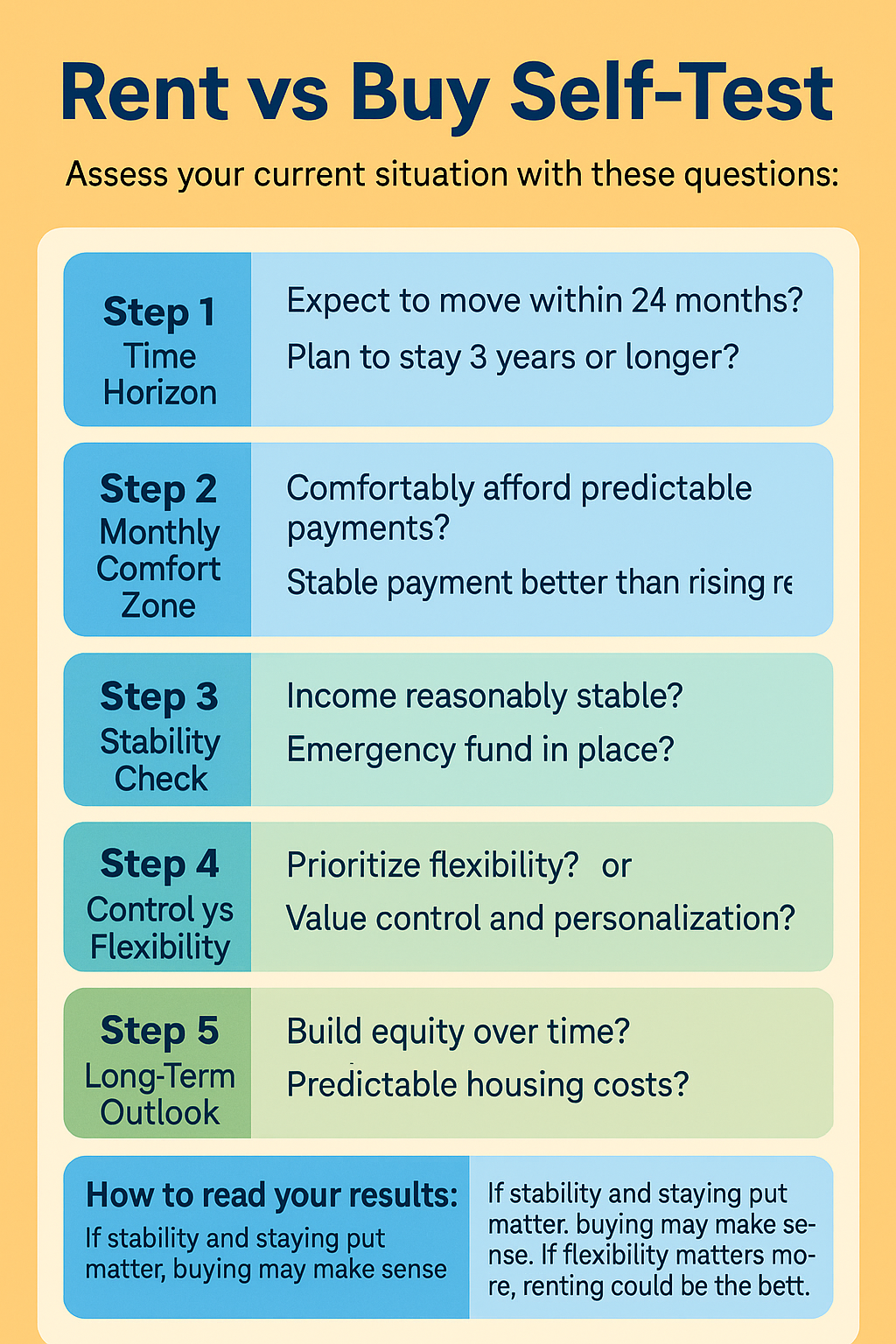
The 60-Second Rent vs Buy Self-Test
If you are stuck in the rent versus buy debate, you are not alone. Most people do not need a calculator right away. They need clarity.
This quick self-test helps you assess which direction makes more sense right now, based on lifestyle, stability, and financial reality, not market hype.
Step 1: Time Horizon
- If you expect to move within the next 24 months, renting often provides flexibility.
- If you plan to stay in the same area for 3 years or longer, buying becomes more competitive.
Step 2: Monthly Comfort Zone
- Can you comfortably afford a predictable monthly payment without financial stress?
- Would a stable payment feel better than annual rent increases?
Step 3: Stability Check
- Is your income reasonably stable?
- Do you have an emergency fund separate from housing costs?
Step 4: Control vs Flexibility
- If flexibility matters most, renting may still fit your life stage.
- If control, personalization, and long-term planning matter more, ownership often feels better.
Step 5: Long-Term Outlook
- Do you want to build equity over time?
- Do you want housing costs that feel more predictable year to year?
If most of your answers point toward stability, predictability, and staying put, buying deserves serious consideration.
If your answers lean toward flexibility and short-term planning, renting may still be the smarter move for now.
This self-test is not a rulebook. It is a starting point. The right decision depends on your goals, your timeline, and your local market.
If you are curious how these answers translate into real options, you can explore available homes and price ranges using the search tool below. Browsing does not require commitment. It simply gives context.