

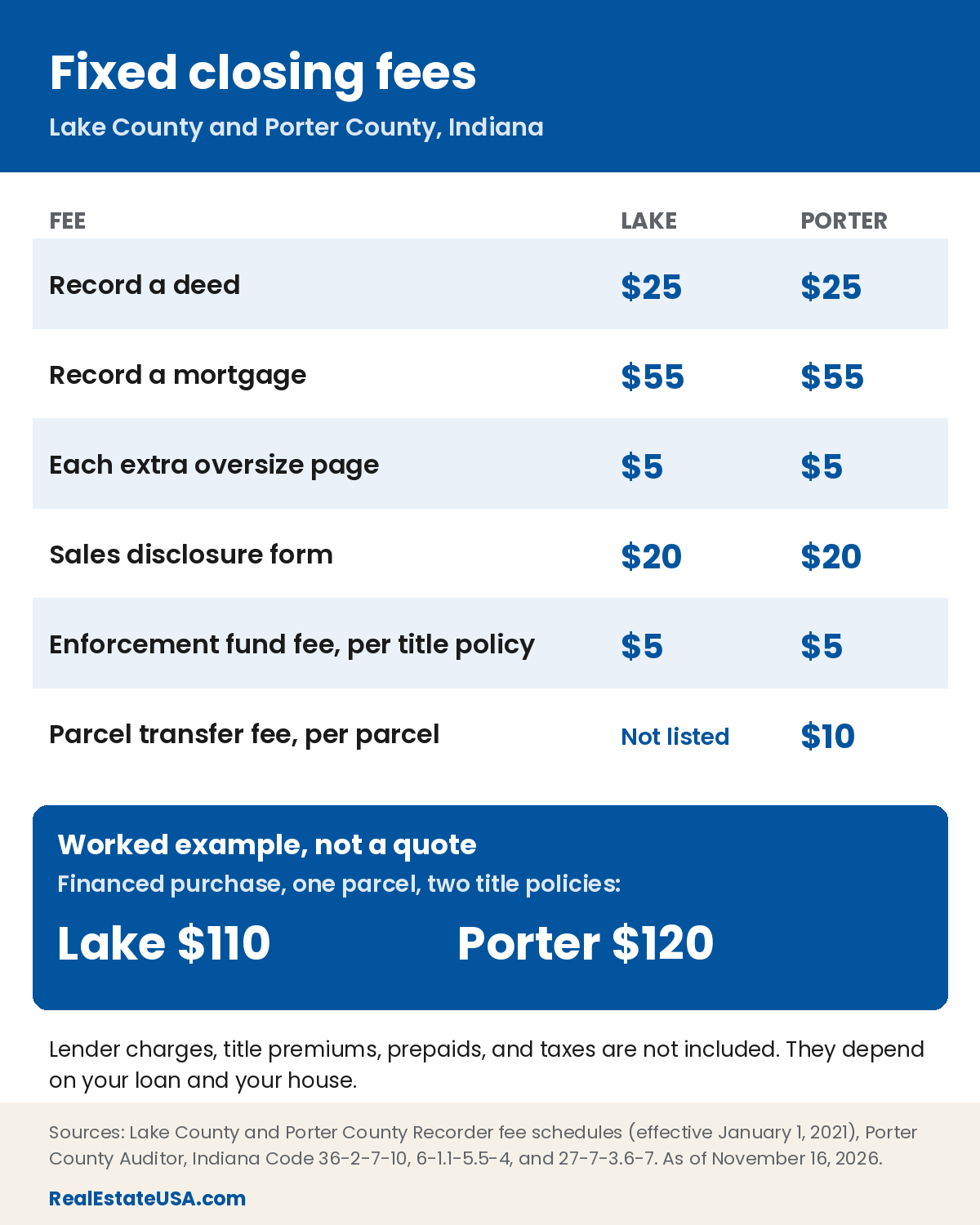
Indiana has no set closing-cost percentage. Your total is the sum of the lines on your statement: lender charges, title insurance, prepaid items, and a few small fixed fees. In Lake and Porter counties, those fixed fees are $25 to record a deed, $55 to record a mortgage, $20 for the sales disclosure form, and $5 per title policy.
Porter County adds a $10 parcel transfer fee. Indiana has no deed transfer tax. Every fee and custom below was checked on November 16, 2026.
Want a net sheet on your house or a cash-to-close check? Call Sash at (219) 808-1520.
It is a little after five on a Tuesday in Crown Point, and the window over the kitchen table has already gone dark blue.
A couple renting a few blocks off the square has the lamp on. The lender emailed their Loan Estimate this afternoon, and they printed it. There is a pen on the table, and the key ring they will hand back to their landlord in the spring.
They know their down payment. What they want to know is the rest. How much are closing costs in Indiana, and which of these lines are theirs?
We hear that question a lot. The answer is not one number. It is a list, and once you see the list, the number stops being scary.
Want the quick version? Sash walks through what buyers and sellers pay, plus the fixed county fees, in this short video.
Why is there no single closing-cost number in Indiana?
Closing costs are not one fee. The CFPB sorts a buyer’s upfront costs into groups: lender charges for making the loan, optional points, third-party services like the appraisal and title insurance, government fees, and prepaid items. Prepaids are the interest to the end of your closing month, the first year of homeowners insurance, and the first deposits into an escrow account.
Several of those lines move with your loan and your house. Points are a percentage of the loan amount. Prepaid interest depends on the day you close. Title premiums come from the insurer, and Fidelity National Title’s 2026 state guide lists Indiana title rates as filed, so each insurer files its own.
So we will not hand you a percentage from a national website. It does not know your loan, your tax bill, or your closing date. What we can give you is every line, who pays it by custom, and the few fees that are the same for everyone.
What do buyers pay at closing in Indiana?
The CFPB puts it plainly. When you buy a home, you pay the costs tied to the purchase and the loan, unless the contract or state law moves some of them to the seller. In Indiana, custom moves a few of them to the seller.
Buyer closing cost lines in Indiana
| Line | Who pays by custom | Source |
|---|---|---|
| Lender charges (origination, application, underwriting) | Buyer | CFPB |
| Points to lower the rate, if you choose them | Buyer, optional | CFPB |
| Appraisal and other services the lender requires | Buyer | CFPB |
| Loan title policy premium | Buyer | Fidelity 2026 |
| Survey | Buyer | Fidelity 2026 |
| Closing or settlement fee | Negotiable, split evenly by custom | Fidelity 2026 |
| Recording the deed ($25) and the mortgage ($55) | Buyer | Fidelity 2026, county fee schedules |
| Title Insurance Enforcement Fund fee ($5 per policy) | Whoever buys that policy | Indiana Code 27-7-3.6-7 |
| Prepaid interest, first year of homeowners insurance, escrow deposits | Buyer | CFPB |
| Sales disclosure form fee ($20) | Set by the contract or closing agent | Indiana Code 6-1.1-5.5-4 |
| Porter County parcel transfer fee ($10 per parcel) | Set by the contract or closing agent | Porter County Auditor |
Customs from Fidelity National Title, Real Estate Laws and Customs by State 2026 (Indiana page). Fees from the Lake County and Porter County Recorder schedules, Indiana Code, and the Porter County Auditor. Data as of November 16, 2026. Your purchase agreement controls.
Custom is where the conversation starts, not where it ends. The purchase agreement can move any line. Seller concessions are a separate negotiation, and they show up as a credit on your statement.
Two buyer lines catch people. The first is homeowners insurance, because the first full year is paid at closing. Our post on homeowners insurance when you buy covers that. The second is the escrow deposit, which starts your tax and insurance cushion. Neither one is a fee to the lender. Both are still cash you bring. If you are still working out the bigger number, start with how much down payment you need.
What do sellers pay at closing in Indiana?
The seller side is a shorter list, and the payoff is the big line. Fidelity’s guide lists the owner’s title policy as a seller cost in Indiana. The seller also pays off the mortgage, and our guide to paying off your mortgage when you sell explains how that payoff figure is set.
Seller closing cost lines in Indiana
| Line | Who pays by custom | Source |
|---|---|---|
| Owner’s title policy premium | Seller | Fidelity 2026 |
| Title search and examination | Varies by county | Fidelity 2026 |
| Closing or settlement fee | Negotiable, split evenly by custom | Fidelity 2026 |
| Payoff of the seller’s mortgage | Seller | Lender payoff statement |
| Recording the mortgage release ($25 as an instrument other than a mortgage) | Ask the title company | County fee schedules |
| Property taxes billed in arrears | Seller credits the buyer, per the purchase agreement | Indiana DLGF |
| Listing brokerage compensation | Negotiable, set in the listing agreement | NAR settlement FAQ |
| Buyer broker pay or seller concessions | Only if negotiated in writing | NAR settlement FAQ |
| Deed transfer tax | None in Indiana | Fidelity 2026 |
Customs from Fidelity National Title 2026 (Indiana page), Indiana DLGF property tax terms, and the NAR settlement FAQ. Data as of November 16, 2026. Your listing agreement and purchase agreement control.
After the payoff, property taxes are the line sellers ask about next. Indiana bills taxes in arrears. The Indiana DLGF defines that as taxes paid this year covering the year before. So the seller has lived in the house for months nobody has billed yet, and the purchase agreement says how that time is credited to the buyer. Our post on property taxes when you buy a home walks through the calendar.
Brokerage compensation is negotiable. The NAR settlement FAQ says compensation is not set by law and is fully negotiable, and it is written into your agreements. Our post on whether buyers pay commission now explains how that changed in 2024.
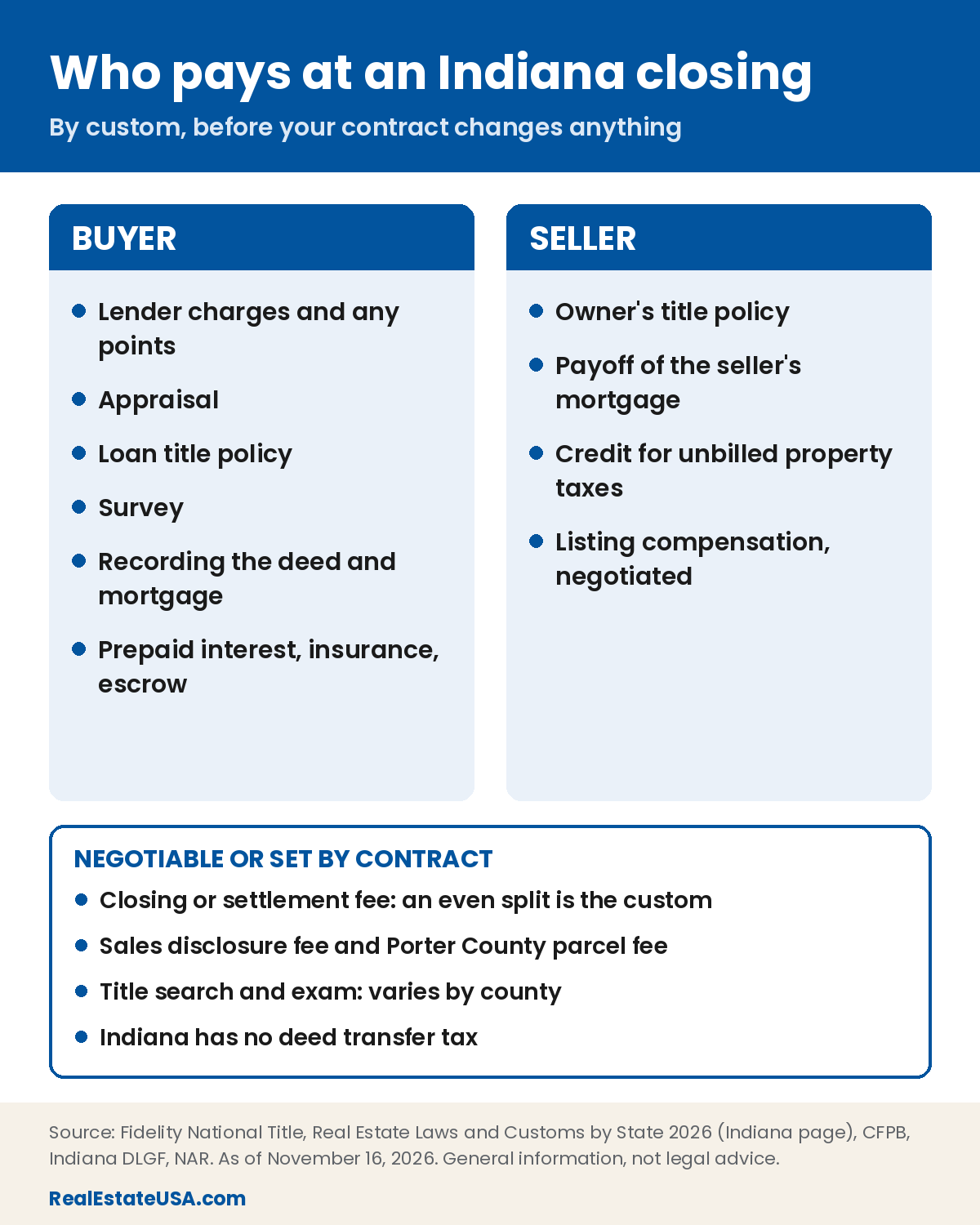
Selling? Ask for a seller net sheet before you list. It starts with your price and subtracts the payoff, the owner’s policy, your share of the closing fee, agreed compensation, the tax credit, and any concessions. That is the number you can plan around.
What are the fixed fees in Lake and Porter counties?
A few fees are the same for every buyer and seller in a county. They are small, but they are the only closing-cost lines we can print to the dollar, because they come from public schedules.
- Recording. The Lake County Recorder and the Porter County Recorder post the same schedule, effective January 1, 2021: $55 for a mortgage and $25 for a deed or any other instrument, plus $5 for each extra page larger than legal size. Indiana Code 36-2-7-10 sets the same $25 and $55.
- Sales disclosure form. $20 to the county auditor under Indiana Code 6-1.1-5.5-4. The DLGF lists the exempt transfers, including transfers to a charity and transfers from foreclosure, divorce, court order, condemnation, or probate.
- Title Insurance Enforcement Fund fee. $5 per title policy under Indiana Code 27-7-3.6-7. The Indiana Department of Insurance says it applies to owner’s policies, loan policies, and second mortgage policies.
- Porter County parcel transfer fee. The Porter County Auditor charges $10 per parcel per deed. The Lake County Recorder schedule does not list it.
Porter County also has a timing rule. Its auditor reviews every deed before accepting it, and in-person filings need at least 72 business hours. Build that into a Valparaiso, Chesterton, or Portage closing date.
Worked example: fixed fees on a financed purchase of one parcel
| Fee | Lake County | Porter County |
|---|---|---|
| Record the deed | $25 | $25 |
| Record the mortgage | $55 | $55 |
| Sales disclosure form | $20 | $20 |
| Enforcement fund fee, owner’s policy | $5 | $5 |
| Enforcement fund fee, loan policy | $5 | $5 |
| Parcel transfer fee, one parcel | Not on the Lake schedule | $10 |
| Fixed fees total | $110 | $120 |
Example only, not a quote. It assumes a financed purchase of one parcel, an owner’s policy and a loan policy, and no sales disclosure exemption. It leaves out lender charges, title premiums, prepaids, and taxes, which depend on your loan and your house. Who pays each fee depends on your contract. Fees from the county schedules and Indiana Code, as of November 16, 2026.
Does Indiana charge a transfer tax?
No. Fidelity’s 2026 guide lists no deed transfer tax and no mortgage tax in Indiana. For anyone selling in the south suburbs and buying here, that is the line you will notice first. Illinois has a state transfer tax, and counties and some cities add their own. Our post on Indiana and Illinois closing costs and title puts the two states side by side.
When will you see your real numbers?
Buyers with a mortgage get a Loan Estimate first, then the Closing Disclosure. The CFPB says the lender has to give you the Closing Disclosure at least three business days before you close. Lay the two side by side and ask about any line that grew. Our guide to the Closing Disclosure shows which lines can change and by how much.
Cash buyers do not get a Closing Disclosure. Ask the title company for the settlement statement, and read the title commitment when it comes in. Sellers see their side on the same statement, so ask for a draft a few days out.
Sash recorded a Short on what closing costs look like on a Lake County home, from the buyer side and the seller side. It is a quick minute before you sit down with your own statement.
Back at the kitchen table in Crown Point
By seven, the Loan Estimate has pencil marks down the margin. They circled the lender charges and the prepaids, the lines that are theirs to plan for. They put a question mark next to the closing fee, because that one is negotiable. They crossed off the owner’s policy, which the seller pays by custom in Indiana.
And next to the recording line, she wrote $25 and $55. Those two will not move. It is a small thing, but it is the first line on the page they understand all the way through.
Next for them is a short list of homes that fit the monthly payment, not just the price. Search homes for sale when you are at that step too.
Work with Realest
Talk to a Realest agent
Want a net sheet on your house, or a closing-cost check before you write an offer? Call Sash and we will go down every line with you.
Call Sash at (219) 808-1520 Search homes for sale
Selling first? Ask for your home value or call Sash at (219) 808-1520.
Would you rather write? Send us a note.
Want us to look over a Loan Estimate or a net sheet with you? Send it our way and we will go through it line by line.
Sash Joveski and Pamela “Pam” Joveski are founding members of Realest. Realest is licensed in Indiana and Illinois and is at 112 S. Main St., Suite B, Crown Point, serving all of Northwest Indiana and Chicagoland.
The photo was generated for this guide on November 16, 2026, then cropped with text added. Shown for illustration only. It is not a photo of any real home.
This guide is general information, not legal, tax, or lending advice. The Crown Point couple is an example, not real clients. Fees and customs were checked on November 16, 2026. Confirm current fees with the county and your title company before closing.
Sources
- Fidelity National Title: Real Estate Laws and Customs by State 2026, Indiana page
- CFPB: What costs come with taking out a mortgage?
- CFPB: What fees or charges are paid when closing on a mortgage, and who pays them?
- CFPB: What is a Closing Disclosure?
- Lake County Recorder: Fees for services (schedule effective January 1, 2021)
- Porter County Recorder: Fee schedule
- Porter County Auditor: Deeds, plats, and subdivisions
- Indiana Code 36-2-7-10, county recorder fees
- Indiana Code 6-1.1-5.5-4, sales disclosure filing fee
- Indiana DLGF: Sales disclosure form overview (August 20, 2025)
- Indiana Code 27-7-3.6-7, Title Insurance Enforcement Fund fee
- Indiana Department of Insurance: Bulletin 139, Title Insurance Enforcement Fund fee
- Indiana DLGF: Property tax terms
- NAR: Settlement FAQs
Ask Realest
Got a quick question about a closing cost line, a net sheet, or what a house nearby might sell for?
Ask Realest answers short buyer, seller, and homeowner questions in plain English, any time of day. Start with buyer closing costs in Northwest Indiana or the seller net sheet answer, and read the longer buyer closing costs guide for Lake and Porter counties.
When you are ready to talk it through, contact us or call Sash at (219) 808-1520.
FAQ
How much are closing costs in Indiana?
There is no set percentage. Your total is the sum of the lines on your statement: lender charges, title insurance, prepaid items, and a few fixed fees. In Lake and Porter counties the fixed fees are $25 to record a deed, $55 to record a mortgage, $20 for the sales disclosure form, and $5 per title policy. Porter County adds $10 per parcel.
Who pays closing costs in Indiana, the buyer or the seller?
Both pay some. By custom the buyer pays the lender’s charges, the loan title policy, the survey, recording, and prepaid items. The seller pays the owner’s title policy and clears the seller’s own mortgage. The closing fee is negotiable, and the purchase agreement can move any line.
Who pays for title insurance in Indiana?
Fidelity National Title’s 2026 state guide lists the owner’s policy premium as a seller cost and the loan policy premium as a buyer cost in Indiana. Each policy also carries a $5 Title Insurance Enforcement Fund fee under Indiana Code 27-7-3.6-7.
Does Indiana have a real estate transfer tax?
No. Fidelity’s 2026 guide lists no deed transfer tax and no mortgage tax in Indiana. That is a big change for people moving from Illinois, where state, county, and some city transfer taxes apply.
What do sellers pay at closing in Northwest Indiana?
Sellers pay off their own mortgage, pay the owner’s title policy by custom, share the closing fee as agreed, and credit the buyer for property taxes that have built up but are not billed yet. Brokerage compensation is negotiable and set in writing. Call Sash at (219) 808-1520 for a net sheet on your house.
What is the sales disclosure fee in Indiana?
It is $20, paid to the county auditor under Indiana Code 6-1.1-5.5-4. Some transfers are exempt, including transfers to a charity and transfers from foreclosure, divorce, court order, condemnation, or probate. The purchase agreement or the closing agent decides which side pays it.
When will I see my final closing costs?
If you are getting a mortgage, the lender has to give you the Closing Disclosure at least three business days before closing, according to the CFPB. Compare it line by line with your Loan Estimate. Cash buyers and sellers get a settlement statement from the title company.