

If the house is your main home, you may owe no federal tax when you sell it. The IRS lets you exclude up to $250,000 of gain, or $500,000 on a joint return, if you owned the home and lived in it for at least 2 of the 5 years before closing. Your closing date sets the tax year.
Indiana starts its income tax with your federal adjusted gross income, and its rate drops from 2.95% in 2026 to 2.90% in 2027. Every rule and rate below was checked on November 21, 2026. This is general information, not tax advice.
Selling this winter and want to see what you would walk away with? Call Sash at (219) 808-1520.
The offer came in on a Tuesday in November. It was a good one, on a brick ranch in Valparaiso with a maple out front that had dropped its last leaves the week before.
The couple selling it had raised two kids there. They had a condo picked out near their daughter, and the buyer’s lender said the loan could close on either of two days: Wednesday, December 30, or Monday, January 4.
Both dates worked for the movers. So the two of them sat at the kitchen table with the purchase agreement, a legal pad, and a plate of cookies nobody was eating, and asked the question we hear every December. Do we pay taxes when we sell our house? And does it matter which day we pick?
For them, the first answer was no. The second answer was yes, a little, and not for the reason they guessed.
Do I pay taxes when I sell my house?
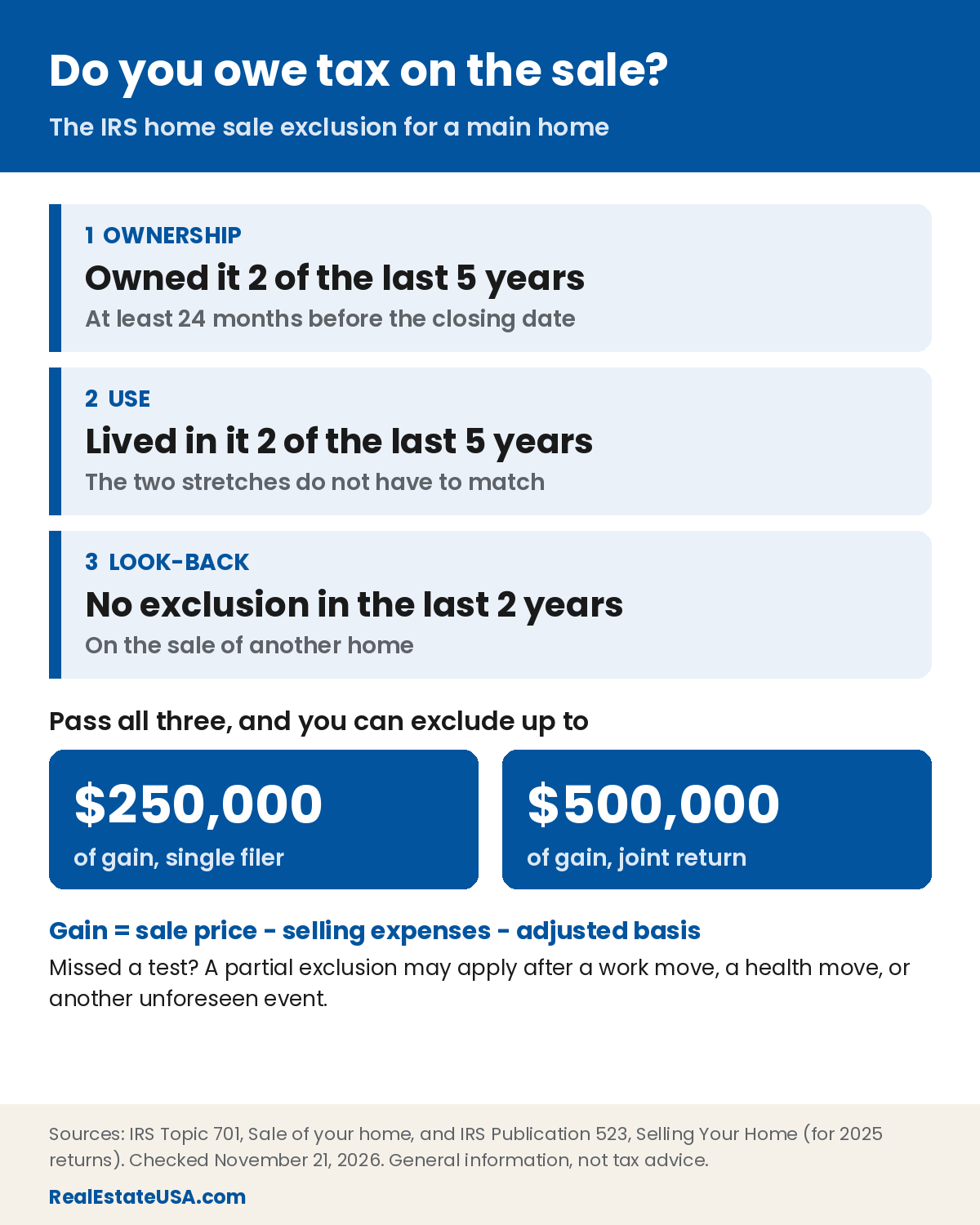
On a main home, the federal answer comes down to one rule. IRS Topic 701 says you may exclude up to $250,000 of gain from your income, or up to $500,000 if you file a joint return with your spouse.
To get it, you have to pass two tests. You, or your spouse, owned the home for at least 24 months of the 5 years before the sale. And you lived in it as your home for at least 24 months of those same 5 years. The two stretches do not have to line up. You could live in it, move out and rent it, then sell, as long as both tests fit inside the 5 years that end on the closing date. Renting it out before you move back in is different: Publication 523 says gain tied to rental or other nonqualified use after 2008 cannot be excluded. And if you ever rented the home or used part of it for business, you cannot exclude gain equal to the depreciation you took or could have taken after May 6, 1997.
There is a look-back rule too. If you excluded gain on another home in the 2 years before this sale, you cannot use the exclusion again yet. IRS Publication 523 also allows a partial exclusion when a sale comes early because of a work-related move, a health-related move, or another unforeseen event, such as a death or a divorce.
The couple in Valparaiso had owned and lived in their ranch for well over 5 years and had never sold another home. They passed all three tests before anyone touched the cookies.
The IRS tests for the home sale exclusion
| Test | What it asks | Source |
|---|---|---|
| Ownership | You or your spouse owned the home for at least 24 months of the 5 years before the closing date | IRS Topic 701 |
| Use | You lived in it as your main home for at least 24 months of those 5 years. The two periods do not have to be the same | IRS Topic 701 |
| Look-back | You did not exclude gain on another home sale in the 2 years before this one | IRS Publication 523 |
| Amount | Up to $250,000 of gain, or up to $500,000 on a joint return | IRS Topic 701 |
| Missed a test? | A partial exclusion may still apply after a work-related move, a health-related move, or another unforeseen event | IRS Publication 523 |
From IRS Topic 701 and IRS Publication 523 (for 2025 returns), checked November 21, 2026. Talk to a tax professional about your own facts.
How do you figure the gain on a house sale?
The exclusion is a limit on gain, not on the sale price. A $600,000 sale can owe nothing, and a $300,000 sale can owe something. It depends on what you paid and what you put into the house.
Publication 523 lays it out in two steps. First, take the sale price and subtract your selling expenses, such as brokerage pay, advertising, and legal fees. That is your amount realized. Then subtract your adjusted basis, which starts with what you paid and grows with each improvement. The answer is your gain.
Improvements are the work that adds value, makes the house last longer, or adapts it to a new use. The IRS list includes a new roof, a furnace, central air, new siding, a deck, a fence, and a kitchen update. Repairs and upkeep do not count. Painting, fixing a leak, and patching a crack stay out of your basis.
That is why the receipts in the kitchen drawer matter. The roof you replaced after a hailstorm, or the furnace that quit one January, can lower your gain dollar for dollar if you can show what you spent.
Worked example: a gain inside the exclusion
| Line | Amount |
|---|---|
| Sale price | $360,000 |
| Minus selling expenses (brokerage pay, legal and advertising fees) | $22,000 |
| Amount realized | $338,000 |
| What you paid for the house | $180,000 |
| Plus improvements (new roof, new furnace, kitchen update) | $42,000 |
| Adjusted basis | $222,000 |
| Gain (amount realized minus adjusted basis) | $116,000 |
| Exclusion limit for a single filer who meets the tests | $250,000 |
Example only, with round numbers, not a quote and not real clients. It follows the steps in IRS Publication 523 (for 2025 returns). Your figures come from your closing statements and receipts. Checked November 21, 2026.
If your gain is above the limit, or you do not qualify, the taxable part is a capital gain. IRS Topic 409 says gain on property held more than 1 year is long-term and can be taxed at 0%, 15%, or 20%, depending on your taxable income. Held 1 year or less, it is taxed as ordinary income. Higher earners may also owe the 3.8% net investment income tax on the taxable part. IRS Topic 559 puts the income thresholds at $200,000 for single filers and $250,000 for married couples filing jointly. A loss on the sale of your own home is not deductible.
Does Indiana tax the gain when you sell a house?
Indiana does not have its own home sale exclusion to learn. Line 1 of the Indiana return is your federal adjusted gross income, according to the Indiana Department of Revenue. Gain you exclude on your federal return does not start out in that number.
If part of your gain is taxable, it shows up there and Indiana taxes it at the state rate. The DOR rate page puts that rate at 2.95% for 2026 and 2.90% for 2027. Your county income tax applies on top of it, and DOR says county rates can change in January and October.
As our Indiana closing costs breakdown notes, Indiana also has no deed transfer tax. That is one less line on a seller’s statement than people moving from Illinois are used to.
Should you close in December or January?
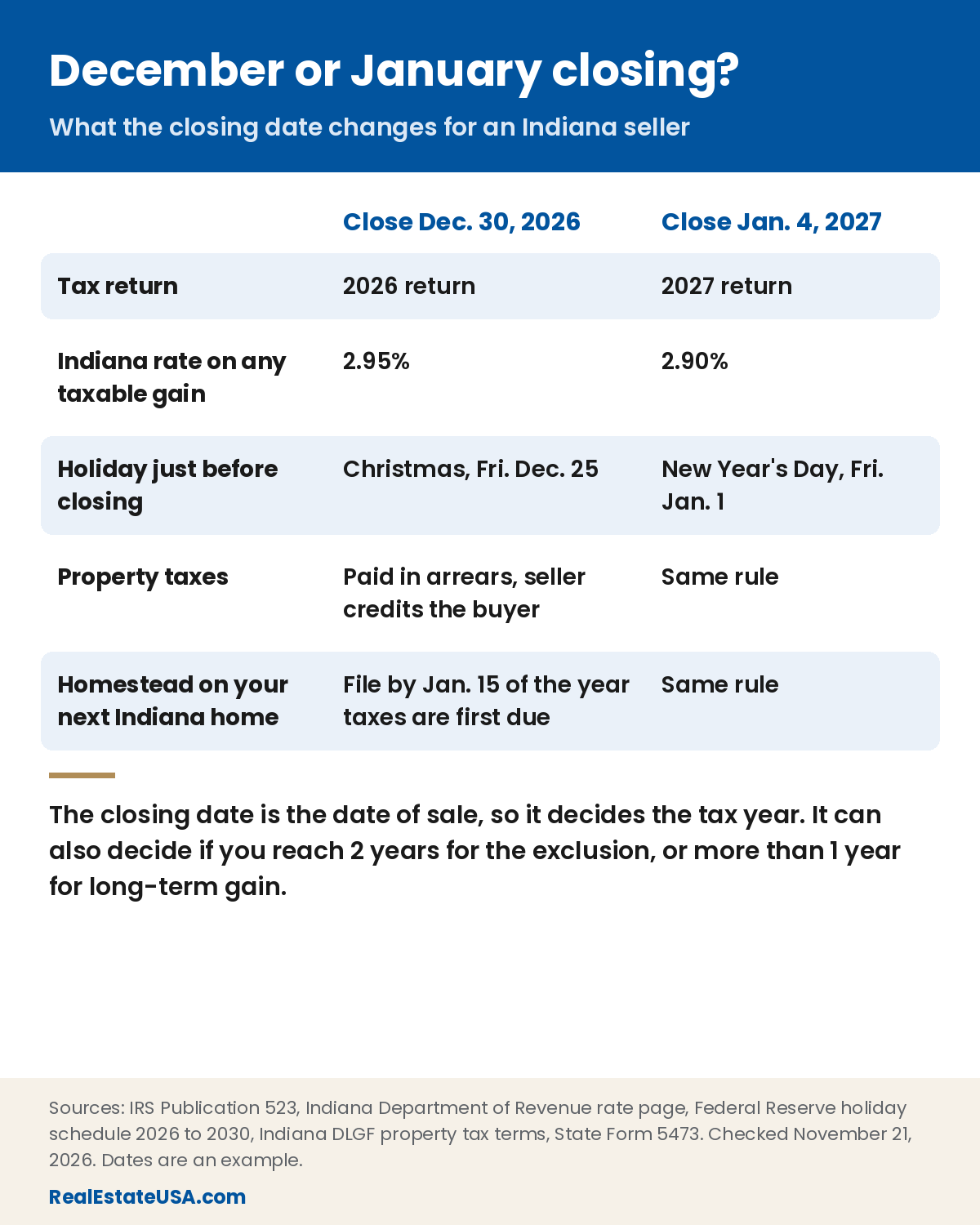
This is the part the Valparaiso couple did not expect. Publication 523 treats the closing date as the date of sale. A December 30 closing puts the sale on your 2026 return. A January 4 closing puts it on your 2027 return, filed in 2028.
For them, with all of the gain excluded, the date changed almost nothing on the tax side. It can change more for other sellers:
- If you are a few days short of 24 months of ownership or living in the home, a January closing might get you over the line.
- If the home is a rental or a second home and you have held it about a year, a closing date past the 1 year mark can make the gain long-term.
- If some of your gain is taxable, the Indiana rate on it is 2.95% for a 2026 sale and 2.90% for a 2027 sale.
- If you expect a big change in income next year, such as a retirement or a new job, your tax preparer may prefer one year over the other.
Property taxes work the same either way. The Indiana DLGF says Indiana property taxes are paid in arrears, in May and November installments. So at closing the seller credits the buyer for taxes that have built up but have not been billed yet. Our Northwest Indiana property tax guide and the Realest property tax due dates page cover the dates.
If you are buying your next home in Indiana, there is one more year-end date. State Form 5473, the homestead deduction claim, says to file it with the county auditor on or before January 15 of the year the taxes are first due. The DLGF deductions page gives its own example: an application completed on or before January 15, 2026, showed up on the 2025 pay 2026 bill. Ask the Lake County or Porter County auditor which bill your new home’s closing date reaches.
December 30 or January 4: what the closing date changes
| Item | Close Dec. 30, 2026 | Close Jan. 4, 2027 | Source |
|---|---|---|---|
| Tax return the sale goes on | 2026 return, filed in 2027 | 2027 return, filed in 2028 | IRS Publication 523, date of sale |
| Indiana income tax rate on any taxable gain | 2.95% | 2.90% | Indiana DOR |
| Federal holiday just before closing | Christmas Day, Friday, December 25 | New Year’s Day, Friday, January 1 | Federal Reserve holiday schedule |
| Property taxes | Paid in arrears, so the seller credits the buyer at closing | Same rule | Indiana DLGF |
| Homestead on your next Indiana home | File with the county auditor by January 15 of the year the taxes are first due | Same rule | State Form 5473 |
From IRS Publication 523, Indiana DOR, the Federal Reserve holiday schedule, Indiana DLGF, and State Form 5473, checked November 21, 2026. Dates are an example. Your tax preparer should look at your own return.
Holiday dates to plan a winter closing around
A closing needs money to move, and money moves on bank days. The Federal Reserve holiday schedule lists Thanksgiving on Thursday, November 26, Christmas Day on Friday, December 25, and New Year’s Day on Friday, January 1, 2027. Ask your title company and the buyer’s lender how they handle those days before you pick a date.
If the buyer has a mortgage, the CFPB says the lender has to give the buyer the Closing Disclosure at least 3 business days before closing. Our Closing Disclosure guide explains the form. With two Friday holidays in a row, a December 30 closing leaves little room for a late change. Ask your title company for its last wire time on December 30 and 31.
Your mortgage payoff needs a fresh payoff statement good through the closing date, too. Our guide on paying off your mortgage when you sell explains why the payoff is higher than your balance. For the rest of a winter listing, from daylight to snow on the walk, see Should you sell your house in winter in Northwest Indiana?
Will you get a Form 1099-S?
Maybe not. The IRS instructions for Form 1099-S let the closing agent skip the form on a main home that sells for $250,000 or less, or $500,000 or less if the seller is married, when every seller signs a written certification that the whole gain is excludable. The certification can come any time on or before January 31 of the year after the sale.
If you do get a 1099-S, Topic 701 says you must report the sale on your return even if all of the gain is excludable. The date of sale is in box 1. You report the sale on Form 8949 and Schedule D when it has to be reported.
What to keep for your tax preparer
- The closing statement from this sale.
- The closing statement from when you bought the house.
- Receipts and contracts for improvements, like a roof, furnace, windows, or an addition.
- Any Form 1099-S or the certification you signed instead.
- Dates you lived in the home, if you ever rented it out or moved away for a stretch.
Before the sale, a seller net sheet shows what you could walk away with after the payoff, closing costs, and credits. Our Indiana closing costs breakdown lists the seller lines, and what to do before you list covers the work before the sign goes up.
Watch Sash explain a seller net sheet
Sash walks through what a seller net sheet counts in under a minute.
Back at the kitchen table in Valparaiso
The couple picked December 30. Not for taxes. Their gain fit inside the $500,000 exclusion with room to spare, so the year did not matter much on their return.
They picked it because the condo was ready, and because they wanted to wake up on New Year’s Day in the new place with the boxes already in the right rooms. They also wanted to see the tree go up downtown one last time as the people who lived on that street.
Before they signed, they took a photo of every page in the folder of receipts, the roof, the furnace, the kitchen. Then they called their tax preparer and asked one question. Which year is better for us? That is the right order.
Looking in Valparaiso? See Valparaiso homes and the Realest Valparaiso community page.
Work with Realest
Talk to a Realest agent
Thinking about selling this winter? Call Sash and we will walk through your price, your net, and the closing dates that fit your plans.
Call Sash at (219) 808-1520 Search homes for sale
Selling first? Ask for your home value or call Sash at (219) 808-1520.
Would you rather write? Send us a note.
Want a net sheet and a closing date plan before you list? Reach out and we will go through it with you.
Pamela (Pam) Joveski is a founding owner of Realest. The Realest about page lists Pam and Sash Joveski as its two founders, open since April 25, 2017. Realest is at 112 S. Main St., Suite B, Crown Point, and serves Northwest Indiana and Chicagoland.
The photo was generated for this guide, then cropped with text added. Shown for illustration only. It is not a photo of any real home.
This guide is general information, not tax, legal, or financial advice. The Valparaiso couple is an example, not real clients, and the numbers in the worked example are round figures for illustration. Rules and rates were checked on November 21, 2026. Talk to a tax professional about your own sale.
Sources
- IRS Topic 701: Sale of your home
- IRS Publication 523: Selling Your Home (for 2025 returns)
- IRS Topic 409: Capital gains and losses
- IRS Instructions for Form 1099-S
- Indiana Department of Revenue: Your Indiana tax return line by line
- Indiana Department of Revenue: Tax rates, fees, and penalties
- Indiana DLGF: Property tax terms
- Indiana DLGF: Deductions and credits
- State Form 5473: Claim for Homestead Property Tax Standard Deduction (R21, 7-25)
- Federal Reserve: Holidays observed, 2026 to 2030
- CFPB: What is a Closing Disclosure?
Ask Realest
Got a quick question about your net, a closing date, or what your house might sell for this winter?
Ask Realest answers short buyer, seller, and homeowner questions in plain English, any time of day. Start with the seller net sheet answer or how long closing takes in Indiana, and read the longer seller closing costs guide for Lake and Porter counties.
Curious what your house could sell for first? Get a home value from Realest. When you are ready to talk it through, contact us or call Sash at (219) 808-1520.
FAQ
Do I pay taxes when I sell my house?
If it is your main home and you meet the IRS tests, you may owe no federal tax on the gain. You can exclude up to $250,000 of gain, or $500,000 on a joint return, if you owned the home and lived in it for at least 2 of the 5 years before the closing date and did not use the exclusion on another home in the 2 years before.
How much profit can I make on a house sale without paying tax?
The limit is on the gain, not the sale price. Gain is the sale price minus selling expenses, minus your adjusted basis, which is what you paid plus improvements like a new roof or furnace. Up to $250,000 of that gain can be excluded, or $500,000 for a married couple filing jointly, if you meet the IRS tests.
Does Indiana tax the profit from selling a house?
Indiana starts its return with your federal adjusted gross income, so gain you exclude on your federal return does not start out in your Indiana income. Any taxable gain is taxed at the Indiana rate, which is 2.95% for 2026 and 2.90% for 2027, plus your county income tax.
Does it matter if I close on my house sale in December or January?
The closing date sets the tax year. A sale that closes on December 30, 2026, goes on your 2026 return. A sale that closes on January 4, 2027, goes on your 2027 return. The date can also decide if you reach the 2 year mark for the exclusion, or the more than 1 year mark for long-term capital gain.
Will I get a Form 1099-S when I sell my house?
Maybe. The closing agent does not have to file Form 1099-S for a main home that sells for $250,000 or less, or $500,000 or less for a married seller, if every seller signs a written certification that the whole gain is excludable. If you do get one, the IRS says you must report the sale even if the gain is excludable. Call Sash at (219) 808-1520 if you want help reading your closing papers.