

An escrow shortage means your escrow account is below the balance your servicer needs for the coming year of property taxes and insurance. After the yearly escrow analysis, your payment can rise twice: once to cover the higher bills, and again to repay the shortage over at least 12 months.
Every rule, date, and dollar threshold below was checked against federal Regulation X, the CFPB, the Indiana Department of Local Government Finance, and the Lake and Porter County treasurers on November 23, 2026. Your loan documents and your servicer have the final word on your account.
Got an escrow letter and wondering what it means for staying or selling? Call Sash at (219) 808-1520.
The letter sat under a stack of Thanksgiving grocery ads for two days before anyone opened it. When it did get opened, it was on the kitchen island of a split-level in Portage, early on a clear, cold morning, next to a bowl of clementines and a cup of coffee going cold.
Annual Escrow Account Disclosure Statement. New monthly payment starting in January. The number was $115 higher than the one she had paid all year.
She had not missed a payment. She had not refinanced. Her rate was fixed. She called us an hour later with the question we hear from homeowners all over Lake and Porter County: why did my mortgage payment go up?
The answer was on page two, under one word. Shortage.
What is an escrow shortage?
Your servicer keeps a target balance in your escrow account, enough to pay the rest of the year’s property taxes and insurance plus a cushion. A shortage is the amount your actual balance falls short of that target when the servicer runs its yearly analysis. That is the definition in Regulation X, 12 CFR 1024.17.
A shortage is not a late payment and not a penalty. It means last year’s estimate was too low. The bills came in higher than the servicer planned for, so the account ran below its target.
A deficiency is different. That is when the account goes negative, because the servicer had to advance its own money to pay a bill.
New to escrow itself? Our guide to what an escrow account is covers how the account is set up at closing, how the cushion works, and how to read every line of the annual statement. This guide stays on the shortage.
How the yearly escrow analysis works
Once a year, at the end of your escrow computation year, the servicer does the math again. Regulation X calls this the escrow analysis. It does three things.
- It sets the target balances for the year ahead.
- It figures your new monthly escrow payment, which can be up to one-twelfth of the taxes and insurance it expects to pay, plus enough to keep a cushion.
- It checks whether the account has a surplus, a shortage, or a deficiency.
The cushion can be no more than one-sixth of the year’s estimated escrow bills. Your servicer can keep less, or none at all.
To estimate next year, the servicer uses any bill it already knows. If a bill is not known yet, the rule lets it use last year’s amount, or last year’s amount raised by no more than the latest yearly change in the Consumer Price Index. For a new home that has not been assessed yet, it can estimate from similar homes nearby.
You get the annual statement within 30 days of the end of the escrow year, along with last year’s projection. Lay the two side by side. The gap between them is the story of your shortage.
The servicer can also run an analysis at other times during the year. It is allowed, not required, so ask if your taxes or premium drop in the middle of the year.
Why your mortgage payment went up: the two-part jump
This is the part that surprises people. An escrow shortage raises your payment in two ways at once.
First, the servicer resets your monthly escrow to match the higher bills. If your taxes and insurance went up, that piece stays up for as long as the bills do.
Second, the shortage gets paid back. If it is spread over 12 months, a slice rides on top of every payment for the next year, then falls away.
Worked example: a $780 escrow shortage
| Line | Yearly | Monthly |
|---|---|---|
| Escrowed taxes and insurance last year | $4,800 a year | $400 |
| New estimate for next year | $5,400 a year | $450 |
| Shortage found in the analysis, spread over 12 payments | $780 | $65 |
| New escrow part of the payment | $515 | |
| Same, if you choose to pay the $780 at once and the servicer accepts it | $450 |
Example only, with round numbers, not a quote and not a real client. The one-twelfth and 12-month rules come from 12 CFR 1024.17, checked November 23, 2026.
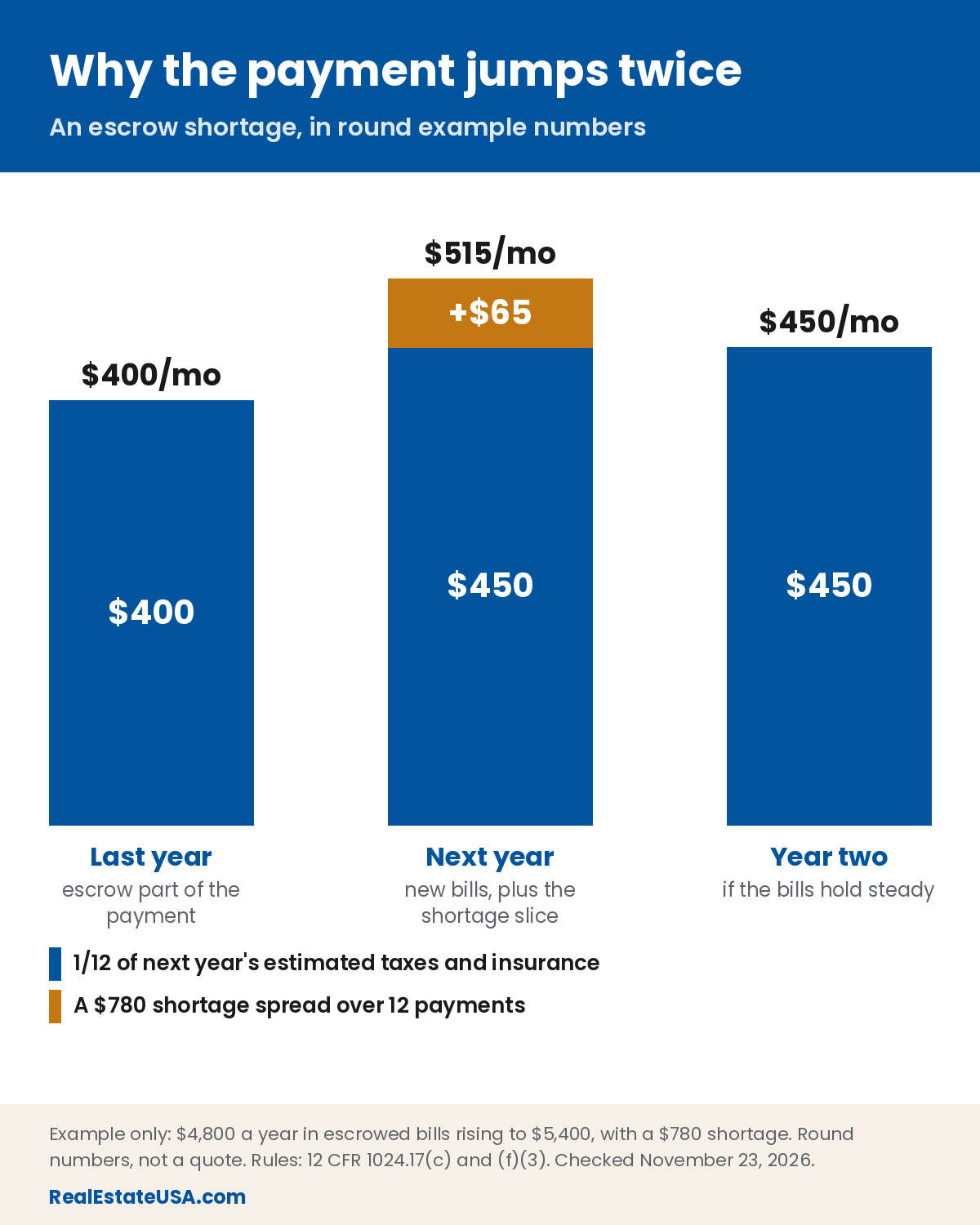
In this example the payment goes up $115 a month. Only $65 of that is the shortage. The other $50 is the new cost of the taxes and insurance themselves, and that part does not go away next year unless the bills come down.
The CFPB lists a change in property taxes or homeowners insurance premiums as a common reason a payment with escrow goes up or down. It also lists a few others worth ruling out, like an adjustable rate, a temporary buydown ending, or a change in mortgage insurance.
Why escrow shortages hit Northwest Indiana homeowners
Indiana property taxes are due twice a year, May 10 and November 10. Porter County says that when a date falls on a weekend or holiday, it moves to the next business day, which is why the DLGF lists May 11, 2026 for this year’s spring payment. Both installments are paid to the county treasurer, and with escrow, your servicer pays them for you.
The tax bill comes out in the spring. Porter County says every taxpayer who is not signed up for eNotices gets a bill in April, even with a mortgage company paying. The state lets counties mark those copies In Escrow or For Informational Purposes Only, per the DLGF tax statement memo, so you do not pay twice. In Lake County, the treasurer bills mortgage companies and tax services automatically under an ID number.
If your servicer built this year’s estimate before the new bill was known, it may have used last year’s number. When the real bill comes in higher, the account runs short. Here is where that tends to come from in Lake and Porter County.
A missing homestead deduction
This one catches buyers in their first year. The DLGF caps fact sheet says a home has to receive the homestead standard deduction to get the 1% property tax cap. Without it, the home falls under the 2% cap for other residential property. A new owner has to claim it. The state claim form says the claim has to be filed with the county auditor by January 15 of the year the taxes are first due.
Bought this year? Check the bill for your name and the homestead line. Our guide to property taxes when you buy a home walks through the first bill, and Realest’s Indiana homestead deduction guide covers the filing.
Deductions that change by law
Indiana’s 2025 property tax law, SEA 1, is moving both homestead deductions a step at a time. The DLGF puts the standard deduction at $48,000 for 2026 bills, and the state claim form steps it down to $40,000 for 2027 bills. At the same time, the supplemental deduction goes from 40% to 46% of the assessed value left after the standard deduction. How that nets out depends on your home’s value and your local tax rate. Watch the spring 2027 bill.
A higher assessment or insurance premium
Your assessed value can go up with the market, and your homeowners insurance premium can go up at renewal. Either one raises next year’s escrow estimate. Our guide to homeowners insurance covers what goes into a premium.
Escrow shortage payment options
Your options depend on how big the shortage is, measured against one month of your escrow payment. Regulation X spells them out, and the CFPB servicing FAQs say those options are the only ones the annual statement can list.
What the escrow analysis can find, and what happens next
| Result | What the servicer can do |
|---|---|
| Surplus of $50 or more | Refund within 30 days of the analysis, if you are current |
| Surplus under $50 | Refund it, or credit it to next year |
| Shortage under one month’s escrow payment | Leave it, ask for it within 30 days, or spread it over at least 12 monthly payments |
| Shortage of one month’s escrow payment or more | Leave it, or spread it over at least 12 monthly payments |
| Deficiency (the account went negative) | Leave it, or collect it in 2 or more equal monthly payments. Under one month, it can also be asked for within 30 days |
From 12 CFR 1024.17(f), checked November 23, 2026. These rules apply when you are current, meaning the servicer gets each payment within 30 days of its due date.
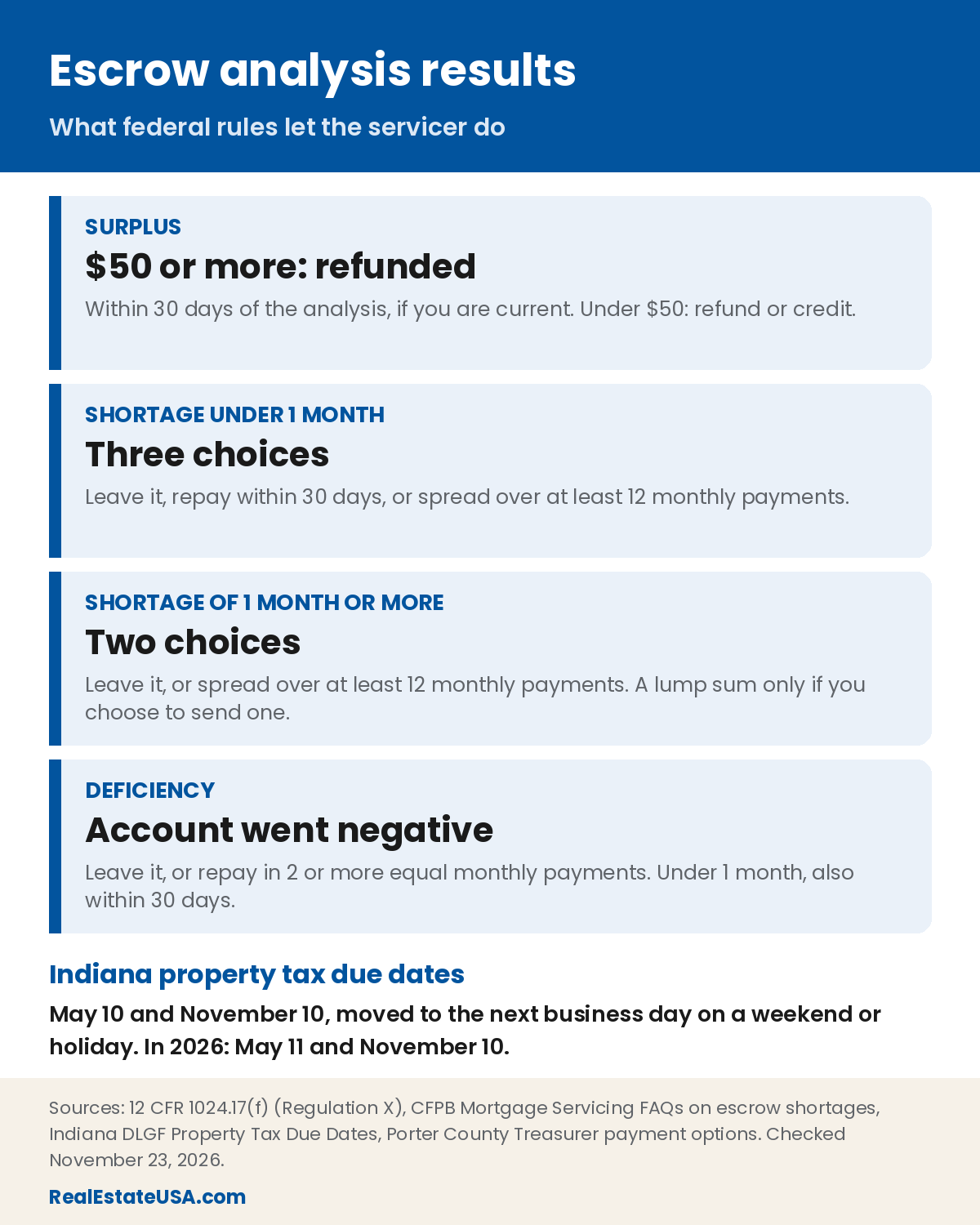
For a shortage of one month’s escrow payment or more, the statement cannot offer you a lump sum. You can still send one. The CFPB says a servicer may accept a lump sum the borrower chooses to pay. If you go that way, ask the servicer to confirm it posted to escrow and to send the new payment amount in writing.
Paying it at once does not undo the first part of the jump. In the example, the payment would still go from $400 to $450, because the bills went up.
Spreading it out keeps cash in your account now. The cost is the same $780 either way. Pick the one that fits your budget this winter.
How to avoid an escrow shortage next year
- Find the homestead line on your tax bill. If it is missing, call the county auditor before the January 15 filing date.
- When the spring bill arrives in April, compare the yearly total to the tax line on your escrow statement.
- When your insurance renews, send the new declarations page to your servicer so the estimate uses the real premium.
- If your assessment looks too high, appeal the assessed value, not the bill. Our property tax assessment appeal guide explains the steps in Lake and Porter County.
- If a bill drops mid-year, ask the servicer whether it will run a new analysis.
- Regulation X also lets you and the servicer agree, after an analysis, to deposit more than the usual limit for one year. Ask if your servicer offers it.
If a number on the statement looks wrong, the CFPB says to call the servicer first, take notes, and ask for a reference number. If that does not fix it, send a written notice of error to the address your servicer lists for errors. It may be different from where you send payments.
Watch Sash on fall tax bills
Fall tax bill feel high? Sash explains why you appeal the assessed value, not the bill.
Back at the kitchen island in Portage
We went through her statement line by line on the phone. The insurance line had gone up at renewal. The tax line was the bigger jump. Her spring bill had come in well above what the servicer projected a year earlier.
The homestead deduction was on the bill, so that was not it. Her assessment had gone up. She decided to look at the appeal steps before the next deadline, and to leave the shortage spread over 12 months.
By the time she hung up, the $115 had a name. About half of it would go away after 12 payments. The other half was the real cost of the house this year.
She slid the statement back in the envelope and wrote one word on it in pencil. April. The day the next tax bill comes.
Work with Realest
Talk to a Realest agent
Payment went up and you are wondering whether to stay, sell, or move to something smaller? Call Sash and we will walk through the numbers with you.
Call Sash at (219) 808-1520 Search homes for sale
Curious what your home would sell for today? Ask for your home value or call Sash at (219) 808-1520.
Would you rather write? Send us a note.
Weighing a move because the payment keeps climbing? Reach out and we will lay out what staying, selling, or buying again would look like.
Pamela (Pam) Joveski is a founding owner of Realest. The Realest about page lists Pam and Sash Joveski as its two founders, open since April 25, 2017. Realest is at 112 S. Main St., Suite B, Crown Point, and serves Northwest Indiana and Chicagoland.
The photo was generated for this guide, then cropped with text added. Shown for illustration only. It is not a photo of any real home.
This guide is general information, not legal, tax, or lending advice. The Portage homeowner is an example, not a real client, and the numbers in the worked example are round figures for illustration. Rules and dates were checked on November 23, 2026 and can change. Your loan documents, your servicer, and your county auditor and treasurer control your escrow and your tax bill.
Sources
- Regulation X, 12 CFR 1024.17 Escrow accounts (Federal Reserve copy)
- CFPB: Regulation X, 1024.17 Escrow accounts
- CFPB: Mortgage Servicing FAQs, escrow shortages
- CFPB: Why did my monthly mortgage payment go up or change?
- Indiana DLGF: Property Tax Due Dates
- Indiana DLGF: Treasurer’s Tax Statement (TS-1) for 2026 memo (PDF)
- Porter County: Property Tax Payment Options
- Lake County Treasurer: Mortgage Company Information
- Indiana DLGF: Property Tax Caps fact sheet, November 2025 (PDF)
- Indiana: Claim for Homestead Standard and Supplemental Deduction, Form HC-10 (PDF)
- Indiana DLGF: Deductions and Credits presentation (PDF)
Ask Realest
Got a quick question about your tax bill, your homestead deduction, or what your house would sell for in Lake or Porter County?
Ask Realest answers short buyer, seller, and homeowner questions in plain English, any time of day. Start with Indiana property taxes and the homestead deduction, then read Realest’s guides to property tax due dates in Lake and Porter County and property tax appeals.
Thinking about selling instead? Get a home value from Realest. When you are ready to talk it through, contact us or call Sash at (219) 808-1520.
FAQ
What is an escrow shortage?
An escrow shortage means the money in your escrow account is below the target balance your servicer needs to pay the coming year of property taxes and insurance, plus any cushion. Federal Regulation X defines it that way, and the yearly escrow analysis is where it shows up.
Why did my mortgage payment go up after the escrow analysis?
Two things can stack. Your servicer resets the monthly escrow amount to one-twelfth of next year’s estimated taxes and insurance, so a higher tax bill or premium raises it. If the account also came up short, a slice of the shortage is added on top, spread over at least 12 months.
Can I pay an escrow shortage in a lump sum?
Yes, if your servicer accepts it. The CFPB says a servicer may take a lump sum you choose to send. For a shortage of one month’s escrow payment or more, the annual statement itself cannot offer a lump sum option. Ask your servicer how to send it and to recalculate the payment afterward.
How do I avoid an escrow shortage next year?
Make sure your homestead deduction is on your tax bill, compare the spring tax bill and your insurance renewal to the escrow statement, and send any premium change to your servicer. If your assessment looks too high, appeal the assessed value with the county.
Do I get a refund if there is an escrow overage?
Yes, when the surplus is $50 or more and you are current on the loan. Regulation X says the servicer must refund it within 30 days of the analysis. Under $50, the servicer can refund it or credit it to next year’s escrow payments.
When are property taxes due in Lake and Porter County?
Indiana property taxes are due May 10 and November 10. When a date falls on a weekend or holiday, it moves to the next business day, which is why the 2026 dates were May 11 and November 10. With escrow, your servicer pays both installments from your account.