

A home inspection checklist in Indiana starts with the state minimum in 878 IAC 1-2-1: structure, exterior, roof, plumbing, electrical, heating, cooling, interiors, insulation, and fireplaces. It leaves out radon, wells, septic systems, wood-destroying insects, and the sewer line, so Northwest Indiana buyers book those separately.
Every rule below was checked against the Indiana Administrative Code, Indiana Code, the Indiana Professional Licensing Agency, and the EPA on November 24, 2026. Your purchase agreement and your inspector’s contract have the final word on your deal.
Under contract and booking an inspection this week? Call Sash at (219) 808-1520.
There was an inch of fresh snow on the roof of the little Cape Cod in Highland the morning of the inspection. The sun was out by ten. It came through the upstairs hall window and landed on the attic hatch, which the inspector had pulled down with its folding ladder.
The buyers stood at the bottom of the ladder with coffee from the drive-through, watching a flashlight beam move across the rafters. They had made an offer the week before Thanksgiving. This was the first time they had seen the attic.
Three hours later the report showed up in their inbox. Forty-one pages. On page six, under Roof, one line stopped them cold. Roof covering not fully inspected. Snow cover.
They called us before they finished reading. Is that allowed? What did we just pay for?
What Indiana requires every home inspector to check
Indiana writes its own standard. The Home Inspectors Licensing Board’s rule, 878 IAC 1-2-1, lists what a licensed inspector has to look at in every home of five or fewer units. It also lists what the inspector does not have to do. The second list matters as much as the first.
The report itself has rules too. It has to name the systems that are significantly deficient or near the end of their service lives, say why when it is not obvious, and give a recommendation to fix or watch each one. It also has to list anything the rule covers that was there on inspection day but was not inspected, and the reason. That is the line our Highland buyers found on page six.
The Indiana home inspection checklist, system by system
| System | The inspector checks | Not required |
|---|---|---|
| Structure | Foundation and framing, probing where rot is suspected. Describes the floor, walls, ceiling, roof structure, and how the crawlspace and attic were checked | Engineering or architectural work |
| Exterior | Siding, flashing, trim, doors, decks, porches, steps and railings, grading and drainage near the house, walks and driveway | Fences, outbuildings, shutters and awnings |
| Roof | Roof covering, gutters and drainage, flashing, skylights, chimneys, and anything poking through. Describes how the roof was inspected | Antennas, chimney flues that are not readily accessible |
| Plumbing | Supply lines, fixtures and faucets, drains and vents, water heater, fuel lines, sump pump. Notes where the main water and fuel shut-offs are | Wells, water softeners, sprinklers, private waste disposal (septic) |
| Electrical | Service and panels, breakers, wiring, a sample of lights, switches and outlets, GFCIs. Reports solid aluminum branch wiring and missing smoke detectors | Alarm systems, low-voltage wiring |
| Heating | Installed heating equipment, vents, flues, chimneys. Describes the fuel and system type | The heat exchanger, humidifier, whether the heat is enough for every room |
| Cooling | Central and through-wall air conditioning. Describes the fuel and system type | Whether the cooling is enough for every room |
| Interior | Walls, ceilings, floors, stairs and railings, counters, a sample of cabinets, doors and windows, garage door and opener | Paint, carpet, window treatments, household appliances |
| Insulation | Insulation and vapor retarders in unfinished spaces, attic and foundation ventilation, exhaust fans | Indoor air quality, moving insulation |
| Fireplaces | Fireplace and wood stove parts, vents, flues, chimneys | Flue interiors, lighting a fire, draft |
Summarized from 878 IAC 1-2-1 (Indiana Home Inspectors Licensing Board), checked November 24, 2026. Inspectors can add services beyond this minimum, and you can ask them to leave items out.
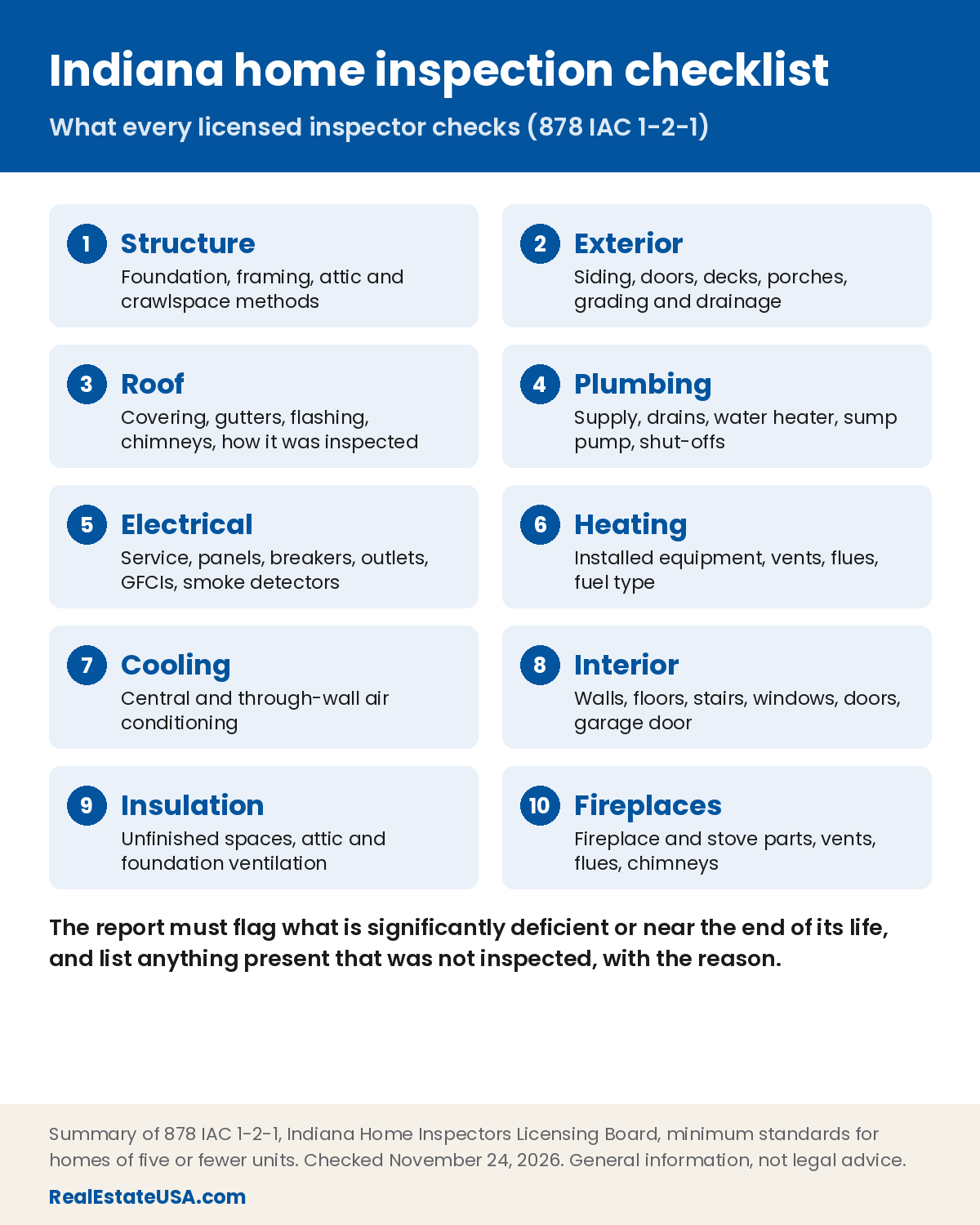
Two words in the rule are worth knowing. Inspectors check what is readily accessible and what is installed. A furnace in a closet stuffed with boxes, or a crawlspace with no way in, can end up on the not-inspected list.
What a standard home inspection leaves out
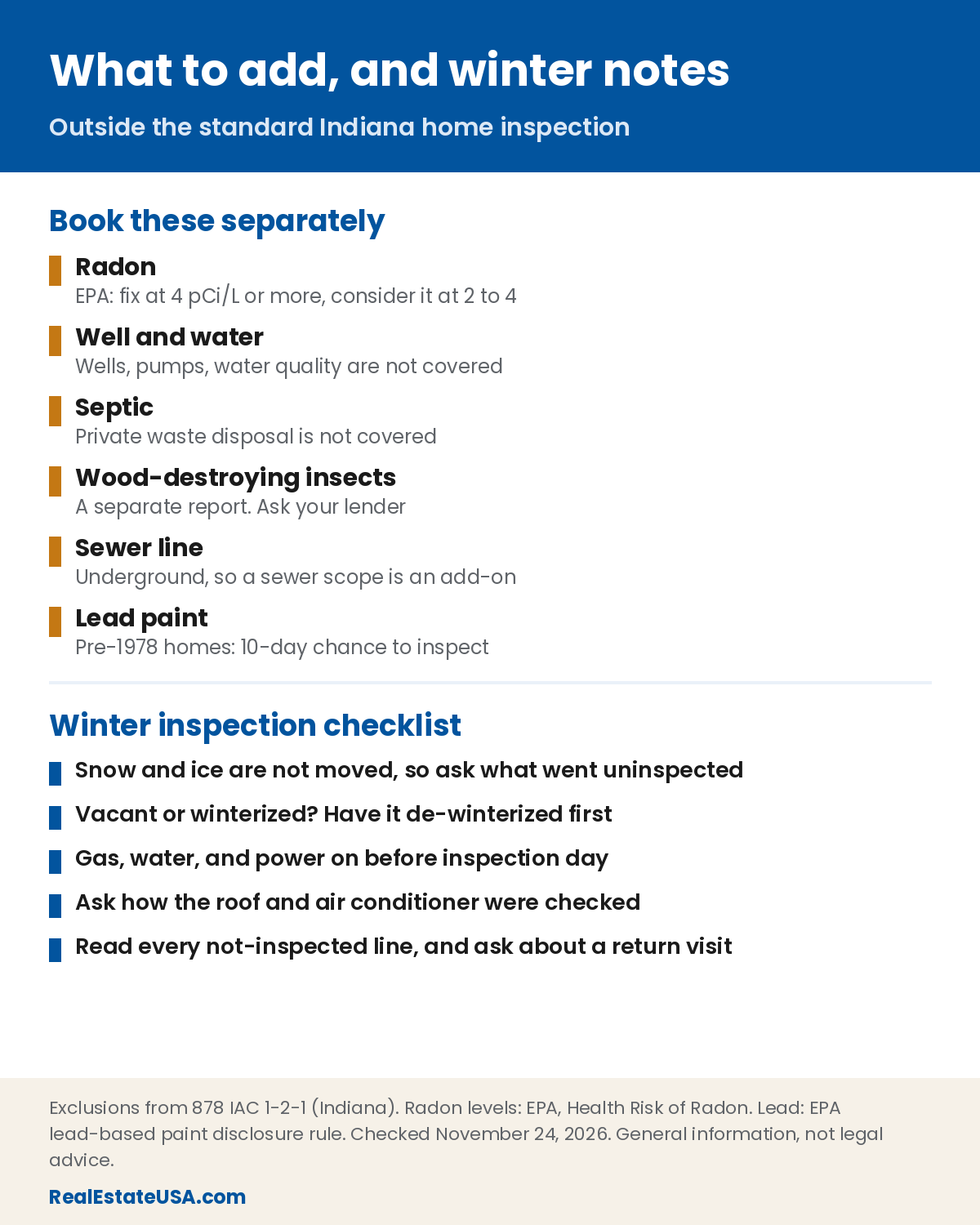
The rule’s general exclusions are long. Inspectors are not required to judge code compliance, how long something will last, what a repair would cost, or if the house is a good buy. A few of the exclusions matter more here than anywhere else.
Radon
The standard inspection does not cover environmental hazards in air, soil, or water. Radon is a separate test. The EPA says to fix a home at 4 pCi/L or more and to consider fixing it between 2 and 4. Our guide to testing for radon in Northwest Indiana covers how the test fits into your inspection period.
Wells and septic systems
Some homes in Lake and Porter County are on a well, a septic system, or both. The Indiana rule says inspectors are not required to inspect wells, well pumps, or private waste disposal systems, or to judge the quantity or quality of the water. Those are their own inspections. Here is our well and septic inspection guide.
Termites and other wood-destroying insects
The rule says inspectors are not required to determine whether wood-destroying organisms are present. A wood-destroying insect inspection is a separate report. Ask your lender if your loan calls for one.
The sewer line
Underground items are outside the standard inspection. The main drain running from the house to the street is one of them. A sewer scope, a camera run down that line, is something you add if you want it. Ask your inspector if they offer one or who does.
Lead paint
Built before 1978? Under the federal disclosure rule, the seller gives you a lead-based paint disclosure and a 10-day chance to have the paint inspected, unless you agree in writing to a different period or waive it. The standard inspection does not test paint. See our lead paint disclosure guide.
Your home inspection checklist for inspection day
This is the list we hand our own buyers once the offer is accepted.
- Check the license. Indiana law says no one may do a home inspection for pay without a home inspector license, unless exempt. Look the inspector up on the state’s license verification site. The license number has to be on the report, too.
- Ask what the inspection covers beyond the state minimum, and book the add-ons now. Radon, well, septic, water, wood-destroying insects, sewer scope.
- Ask the listing agent to make sure the gas, water, and electricity are on, and that the attic hatch, crawlspace, panel, and furnace are reachable.
- Go. Walk the house with the inspector at the end. Ask where the main water and gas shut-offs are. The report has to tell you, and it is easier to remember after you have seen them.
- Read the summary first, then the not-inspected list. Then read everything else.
- Mark your calendar. Your inspection period has a deadline in the purchase agreement. Our home inspection contingency guide covers how it works in Indiana.
Winter home inspection checklist for Northwest Indiana
Inspections go on all winter here. A few rules in the Indiana standard come into play when it is cold. Our guide to buying a house in winter covers the rest of the season.
Snow and ice stay where they are
The rule says inspectors are not required to move snow, ice, soil, debris, furniture, or personal property. A roof under snow, a buried window well, or a frozen-over patio can all end up as not inspected. The inspector still has to describe how they inspected the roof, so look for that line.
Nothing that could cause damage
Inspectors are not required to do anything they think could damage the house or its systems, or to walk anywhere they think is dangerous. A steep, icy roof is a common example. So is equipment that is not meant to run in the cold. Ask the inspector how they checked the air conditioner, and if they will come back in spring.
Vacant and winterized homes
Inspectors are not required to operate any system that is shut down or does not respond to normal controls. A bank-owned or vacant home that has been winterized, with the water off and the lines drained, can come back with the whole plumbing section marked not inspected. Ask the seller to have it de-winterized and the utilities turned on before inspection day.
The furnace gets a real workout
Cold weather is a good time to see heat run. The inspector checks the installed heating equipment and its vents and flues. They are not required to inspect the heat exchanger or judge whether every room gets enough heat. If the furnace is old, the report may call it near the end of its service life. That is your cue to ask for a furnace contractor’s opinion inside your inspection period.
What happens after the report
Once you have the report, you decide what to ask for. In Indiana that answer goes back to the seller inside your inspection period, as the purchase agreement sets it out. Our inspection contingency guide walks through repair requests, credits, and walking away.
Selling instead? A pre-listing inspection can show you what a buyer’s inspector will find. Weighing a home warranty? It does not replace an inspection. And whatever gets fixed, check it at the final walkthrough.
Back at the Cape Cod in Highland
We read the roof line to them over the phone. The inspector had looked at the roof from the ground and from the attic. He saw the rafters, the decking, and no stains around the chimney. What he could not see was the shingles under the snow.
So they asked. The sellers agreed to let the inspector come back after a thaw, still inside the inspection period. Four days later the snow was gone. He walked the roof for twenty minutes and wrote two lines. Shingles worn but serviceable. Flashing at the chimney needs sealing.
They asked the sellers to seal the flashing. The sellers said yes. On the way out, one of them stopped at the attic hatch, pulled the cord, and watched the ladder fold back up into the ceiling.
Their house now. Every page of it.
Work with Realest
Talk to a Realest agent
Under contract and not sure what to ask for after the report? Call Sash and we will go through it with you, line by line.
Call Sash at (219) 808-1520
Search homes for sale
Selling before you buy? Ask for your home value or call Sash at (219) 808-1520.
Would you rather write? Send us a note.
Looking for a house to inspect in the first place? Search homes for sale across Lake and Porter County, or reach out and tell us what you need.
Pamela (Pam) Joveski is a founding owner of Realest. The Realest about page lists Pam and Sash Joveski as its two founders, open since April 25, 2017. Realest is at 112 S. Main St., Suite B, Crown Point, and serves Northwest Indiana and Chicagoland.
The photo was generated for this guide, then cropped with text added. Shown for illustration only. It is not a photo of any real home.
This guide is general information, not legal advice. The Highland buyers are an example, not real clients. Rules were checked on November 24, 2026 and can change. Your purchase agreement, your inspector’s contract, and your own attorney control your deal.
Sources
- 878 IAC 1-2-1, Minimum standards of competent performance of home inspections (LII copy)
- Indiana Register: Title 878, Article 1, Home Inspectors Licensing Board
- Indiana Code 25-20.2, Home Inspectors (PDF)
- Indiana Professional Licensing Agency: Home Inspectors Licensing Information
- Indiana license verification
- EPA: Health Risk of Radon
- EPA: Real Estate Disclosures about Potential Lead Hazards
Ask Realest
Got a quick question about an inspection report, a repair request, or what a house in Lake or Porter County would sell for?
Ask Realest answers short buyer, seller, and homeowner questions in plain English, any time of day. For the full path from offer to keys, read Realest’s buying guides.
Thinking about selling too? Get a home value from Realest. When you are ready to talk it through, contact us or call Sash at (219) 808-1520.
FAQ
What is on a home inspection checklist in Indiana?
Indiana’s minimum standards, 878 IAC 1-2-1, have licensed inspectors check the structure, exterior, roof, plumbing, electrical, heating, central and through-wall cooling, interiors, insulation and ventilation, and fireplaces. The written report has to flag what is significantly deficient or near the end of its service life, and what was present but not inspected, with the reason.
Does a home inspection include radon in Indiana?
No. The state standards say inspectors are not required to determine environmental hazards in the air, soil, or water, so radon is a separate test you order. The EPA says to fix a home at 4 pCi/L or more and to consider fixing it between 2 and 4 pCi/L.
Does a home inspector check the well and septic system?
Not under the standard inspection. Indiana’s rule says inspectors are not required to inspect wells, well pumps, or private waste disposal systems, or to judge the quantity or quality of the water. If the house has a well or septic, book those inspections and a water test separately.
Can you get a home inspection in winter?
Yes. Indiana inspectors are not required to move snow or ice, or to do anything they think could damage the house or its systems. They do have to describe how they inspected the roof and list anything present that they did not inspect, with the reason. Read those lines closely and ask what a return visit would cost.
How do I check a home inspector’s license in Indiana?
Indiana law says a person may not do a home inspection for pay without a home inspector license, unless exempt. You can look up a license on the state’s license verification site, and the inspector’s Indiana license number has to appear on the written report.
Does a home inspector check the appliances?
Not under Indiana’s minimum standards. Inspectors are not required to inspect household appliances, central vacuums, or recreational facilities. Some inspectors add appliances on their own, so ask what yours covers before inspection day.